
50-18-0
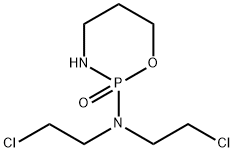
Product Name:
Cyclophosphamide
Formula:
C7H15Cl2N2O2P
Synonyms:
2-[Bis(2-chloroethyl)amino]tetrahydro-2H-1,3,2-oxazaphosphorine 2-oxide;Cyclophosphamide monohydrate;Cytoxan
Inquiry
CHEMICAL AND PHYSICAL PROPERTIES
| Physical Description | Cyclophosphamide is a fine white crystalline powder. Odorless with a slightly bitter taste. Melting point 41-45 °C. A 2% solution has pH of 4 to 6. Used medicinally as an antineoplastic agent. |
|---|---|
| Color/Form | LIQUEFIES ON LOSS OF ITS WATER OF CRYSTALLIZATION |
| Odor | Odorless |
| Taste | Slightly bitter |
| Boiling Point | 336 °C |
| Melting Point | 106 to 113 °F (NTP, 1992) |
| Flash Point | 113 °C c.c. |
| Solubility | 10 to 50 mg/mL at 73 °F (NTP, 1992) |
| Density | 1.48 g/cm³ |
| Vapor Pressure | 0.0000445 [mmHg] |
| LogP | 0.8 |
| Stability/Shelf Life | AQ SOLN KEEPS FOR A FEW HR @ ROOM TEMP, BUT HYDROLYSIS OCCURS ABOVE 30 °C, REMOVES CHLORINE ATOMS; DARKENS ON EXPOSURE TO LIGHT /MONOHYDRATE/ |
| Decomposition | When heated to decomposition it emits highly toxic fumes of /phosphorus oxides, nitrogen oxides, & hydrogen chloride/. |
| Other Experimental Properties | Fine, white, crystalline powder; odorless or almost odorless; slightly bitter taste /Monohydrate/ |
| Chemical Classes | Other Classes -> Other Organic Compounds |
COMPUTED DESCRIPTORS
| Molecular Weight | 261.08 g/mol |
|---|---|
| XLogP3 | 0.6 |
| Hydrogen Bond Donor Count | 1 |
| Hydrogen Bond Acceptor Count | 4 |
| Rotatable Bond Count | 5 |
| Exact Mass | 260.0248201 g/mol |
| Monoisotopic Mass | 260.0248201 g/mol |
| Topological Polar Surface Area | 41.6 Ų |
| Heavy Atom Count | 14 |
| Formal Charge | 0 |
| Complexity | 212 |
| Isotope Atom Count | 0 |
| Defined Atom Stereocenter Count | 0 |
| Undefined Atom Stereocenter Count | 1 |
| Defined Bond Stereocenter Count | 0 |
| Undefined Bond Stereocenter Count | 0 |
| Covalently-Bonded Unit Count | 1 |
| Compound Is Canonicalized | Yes |
PRODUCT INTRODUCTION
description
Cyclophosphamide is a fine white crystalline powder. Odorless with a slightly bitter taste. Melting point 41-45 °C. A 2% solution has pH of 4 to 6. Used medicinally as an antineoplastic agent.