
CHEMICAL AND PHYSICAL PROPERTIES
| Collision Cross Section | 387.3 Ų [M+2H]2+ [CCS Type: DT, Method: stepped-field] |
|---|
COMPUTED DESCRIPTORS
| Molecular Weight | 1296.5 g/mol |
|---|---|
| XLogP3 | -1.1 |
| Hydrogen Bond Donor Count | 16 |
| Hydrogen Bond Acceptor Count | 18 |
| Rotatable Bond Count | 37 |
| Exact Mass | 1295.67749058 g/mol |
| Monoisotopic Mass | 1295.67749058 g/mol |
| Topological Polar Surface Area | 496 Ų |
| Heavy Atom Count | 93 |
| Formal Charge | 0 |
| Complexity | 2550 |
| Isotope Atom Count | 0 |
| Defined Atom Stereocenter Count | 11 |
| Undefined Atom Stereocenter Count | 0 |
| Defined Bond Stereocenter Count | 0 |
| Undefined Bond Stereocenter Count | 0 |
| Covalently-Bonded Unit Count | 1 |
| Compound Is Canonicalized | Yes |
PRODUCT INTRODUCTION
description
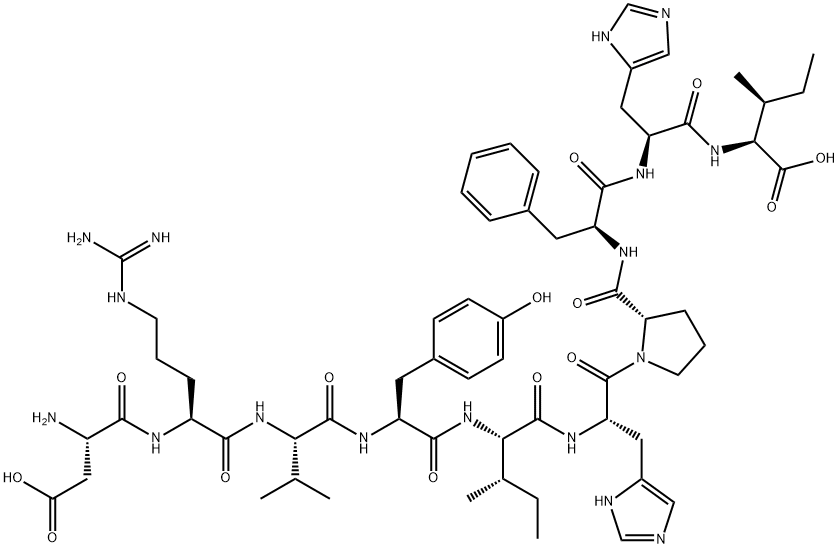
Angiotensin I is a ten amino acid peptide formed by renin cleavage of angiotensinogen. Angiotensin I has no direct biological function except that high levels can stimulate catecholamine production. It is metabolized to its biologically active byproduct angiotensin II, a potent vasoconstrictor, by angiotensin converting enzyme (ACE) through cleavage of the two terminal amino acids. It has a role as a neurotransmitter agent and a human metabolite. It is a tautomer of an angiotensin I dizwitterion.