
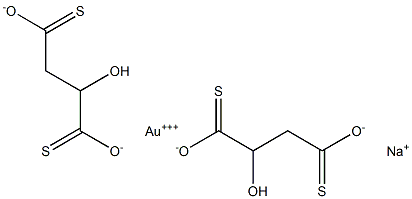
CHEMICAL AND PHYSICAL PROPERTIES
| Color/Form | White to yellowish-white powder; mixture of mono- and disodium salts |
|---|---|
| Odor | Odorless |
| Taste | Metallic taste |
| Solubility | Very soluble in water; practically insoluble in alcohol, ether |
| Stability/Shelf Life | Following the date of manufacture, ... gold sodium thiomalate injection /has an expiration date/ of 5 years. |
| Other Experimental Properties | Aqueous solutions are colorless to pale yellow; pH of 5% aq solution: 5.8-6.5 |
COMPUTED DESCRIPTORS
| Molecular Weight | 408.09 g/mol |
|---|---|
| Hydrogen Bond Donor Count | 1 |
| Hydrogen Bond Acceptor Count | 6 |
| Rotatable Bond Count | 1 |
| Exact Mass | 407.931878 g/mol |
| Monoisotopic Mass | 407.931878 g/mol |
| Topological Polar Surface Area | 82.3 Ų |
| Heavy Atom Count | 13 |
| Formal Charge | 0 |
| Complexity | 122 |
| Isotope Atom Count | 0 |
| Defined Atom Stereocenter Count | 0 |
| Undefined Atom Stereocenter Count | 1 |
| Defined Bond Stereocenter Count | 0 |
| Undefined Bond Stereocenter Count | 0 |
| Covalently-Bonded Unit Count | 5 |
| Compound Is Canonicalized | Yes |
PRODUCT INTRODUCTION
description
Gold Sodium Thiomalate is the sodium salt of gold thiomalic acid, an organogold compound with antirheumatic and potential antineoplastic activities. Gold sodium thiomalate (GST) appears to inhibit the activity of atypical protein kinase C iota (PKCiota) by forming a cysteinyl-aurothiomalate adduct with the cysteine residue Cys-69 within the PB1 binding domain of PKCiota. This prevents the binding of Par6 (Partitioning defective protein 6) to PKCiota, thereby inhibiting PKCiota-mediated oncogenic signaling, which may result in the inhibition of tumor cell proliferation, the promotion of tumor cell differentiation, and the induction of tumor cell apoptosis. Atypical PKCiota, a serine/threonine kinase overexpressed in numerous cancer cell types, plays an important role in cancer proliferation, invasion, and survival; Par6 is a scaffold protein that facilitates atypical PKC-mediated phosphorylation of cytoplasmic proteins involved in epithelial and neuronal cell polarization.