
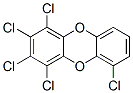
CHEMICAL AND PHYSICAL PROPERTIES
| Solubility | In water, 1.20X10⁻⁴ mg/l @ 20 °C |
|---|---|
| Vapor Pressure | 5.60X10⁻¹⁰ mm Hg @ 25 °C |
| LogP | log Kow = 6.50 (avg of 9 isomers) |
| Kovats Retention Index | 2586 2573 2573 |
| Other Experimental Properties | /Toxic equivalency factors (TEF), indicate the toxicity of a compound relative to 2,3,7,8-tetrachlorodibenzo-p-dioxin, which itself has been assigned a TEF of 1.0. Concentration data for polychlorinated dibenzo-p-dioxins are frequently reported in units of toxic equivalency which are equal to the measured concentration of substance multiplied by its TEF./ The TEF for pentachlorodibenzo-p-dioxins (excluding 1,2,3,7,8-pentachlorodibenzo-p-dioxin) is 0. The TEF for 1,2,3,7,8-pentachlorodibenzo-p-dioxin is 0.5. |
| Chemical Classes | Other Classes -> Halogenated Polyaromatics |
COMPUTED DESCRIPTORS
| Molecular Weight | 356.4 g/mol |
|---|---|
| XLogP3 | 6.3 |
| Hydrogen Bond Donor Count | 0 |
| Hydrogen Bond Acceptor Count | 2 |
| Rotatable Bond Count | 0 |
| Exact Mass | 355.854618 g/mol |
| Monoisotopic Mass | 353.857568 g/mol |
| Topological Polar Surface Area | 18.5 Ų |
| Heavy Atom Count | 19 |
| Formal Charge | 0 |
| Complexity | 344 |
| Isotope Atom Count | 0 |
| Defined Atom Stereocenter Count | 0 |
| Undefined Atom Stereocenter Count | 0 |
| Defined Bond Stereocenter Count | 0 |
| Undefined Bond Stereocenter Count | 0 |
| Covalently-Bonded Unit Count | 1 |
| Compound Is Canonicalized | Yes |
PRODUCT INTRODUCTION
description
1,2,3,4,6-Pentachlorodibenzo-p-dioxin is one of 75 chlorinated dibenzo-p-dioxin (CDD) congeners. CDDs are a class of manufactured chemicals that consist of dioxin skeletel structures with chlorine substituents. They are also persistent organic pollutants (POPs), thus their production is regulated in most areas. Dioxins occur as by-products from the manufacture of organochlorides, the bleaching of paper, chlorination by waste and drinking water treatment plants, municipal solid waste and industrial incinerators, and natural sources such as volcanoes and forest fires. (L177, L178)