
CHEMICAL AND PHYSICAL PROPERTIES
| Melting Point | 182 °C |
|---|---|
| LogP | 3.61 |
| Kovats Retention Index | 2940 2980 |
COMPUTED DESCRIPTORS
| Molecular Weight | 392.5 g/mol |
|---|---|
| XLogP3 | 3.8 |
| Hydrogen Bond Donor Count | 0 |
| Hydrogen Bond Acceptor Count | 3 |
| Rotatable Bond Count | 6 |
| Exact Mass | 392.246378268 g/mol |
| Monoisotopic Mass | 392.246378268 g/mol |
| Topological Polar Surface Area | 32.8 Ų |
| Heavy Atom Count | 29 |
| Formal Charge | 0 |
| Complexity | 495 |
| Isotope Atom Count | 0 |
| Defined Atom Stereocenter Count | 1 |
| Undefined Atom Stereocenter Count | 0 |
| Defined Bond Stereocenter Count | 0 |
| Undefined Bond Stereocenter Count | 0 |
| Covalently-Bonded Unit Count | 1 |
| Compound Is Canonicalized | Yes |
PRODUCT INTRODUCTION
description
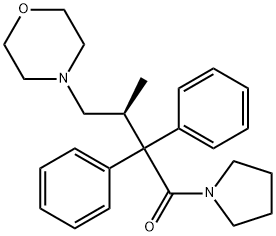
Dextromoramide is an N-acylpyrrolidine arising by formal condensation of pyrrolidine with (3S)-3-methyl-4-(morpholin-4-yl)-2,2-diphenylbutanoic acid. An opioid analgesic that is structurally related to methadone, it is more poweful than morphine but shorter acting. It has been used (particularly as the hydrogen tartrate salt) for the treatment of severe pain, but was discontinued in the UK in 2004. It has a role as an opioid analgesic. It is a member of morpholines and a N-acylpyrrolidine.