
3545-67-3
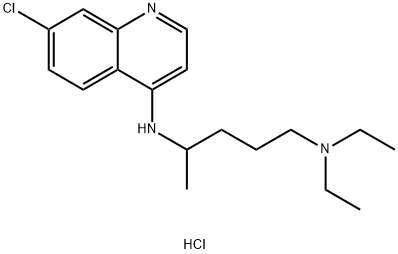
Product Name:
N4-(7-chloro-4-quinolyl)-N1,N1-diethylpentane-1,4-diamine dihydrochloride
Formula:
C18H28Cl3N3
Inquiry
COMPUTED DESCRIPTORS
| Molecular Weight | 392.8 g/mol |
|---|---|
| Hydrogen Bond Donor Count | 3 |
| Hydrogen Bond Acceptor Count | 3 |
| Rotatable Bond Count | 8 |
| Exact Mass | 391.134881 g/mol |
| Monoisotopic Mass | 391.134881 g/mol |
| Topological Polar Surface Area | 28.2 Ų |
| Heavy Atom Count | 24 |
| Formal Charge | 0 |
| Complexity | 309 |
| Isotope Atom Count | 0 |
| Defined Atom Stereocenter Count | 0 |
| Undefined Atom Stereocenter Count | 1 |
| Defined Bond Stereocenter Count | 0 |
| Undefined Bond Stereocenter Count | 0 |
| Covalently-Bonded Unit Count | 3 |
| Compound Is Canonicalized | Yes |
PRODUCT INTRODUCTION
description
Chloroquine Hydrochloride is the hydrochloride salt of chloroquine, a synthetic quinoline with antimalarial and anti-inflammatory properties. Chloroquine is the most widely used drug against malaria, except for those cases caused by chloroquine resistant Plasmodium falciparum. Although the mechanism of action is not fully understood, chloroquine is shown to inhibit the parasitic enzyme heme polymerase that converts the toxic heme into non-toxic hemazoin, thereby resulting in the accumulation of toxic heme within the parasite. Chloroquine may also interfere with the biosynthesis of nucleic acids.