
35061-50-8
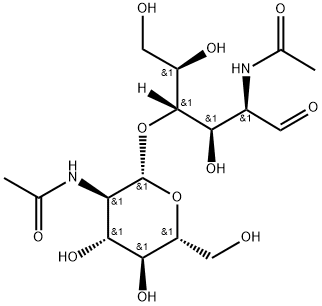
Product Name:
N,N'-Diacetylchitobiose
Formula:
C16H28N2O11
Synonyms:
2-Acetamido-2-deoxy-4-O-(2-acetamido-2-deoxy-β-D -gluco-pyranosyl)-D -glucopyranose;4-O-(2-Acetamido-2-deoxy-β-D -glucopyranosyl)-2-acetamido-2-deoxy-D -glucose;Chitobiose
Inquiry
CHEMICAL AND PHYSICAL PROPERTIES
| Collision Cross Section | 192.9 Ų [M+H]+ [CCS Type: DT, Method: single field calibrated with Agilent tune mix (Agilent)] |
|---|
SAFETY INFORMATION
| Signal word | Warning |
|---|---|
| Pictogram(s) |
 Exclamation Mark Irritant GHS07 |
| GHS Hazard Statements |
H315:Skin corrosion/irritation H319:Serious eye damage/eye irritation |
| Precautionary Statement Codes |
P264:Wash hands thoroughly after handling. P264:Wash skin thouroughly after handling. P280:Wear protective gloves/protective clothing/eye protection/face protection. P302+P352:IF ON SKIN: wash with plenty of soap and water. P305+P351+P338:IF IN EYES: Rinse cautiously with water for several minutes. Remove contact lenses, if present and easy to do. Continuerinsing. P332+P313:IF SKIN irritation occurs: Get medical advice/attention. P337+P313:IF eye irritation persists: Get medical advice/attention. |
COMPUTED DESCRIPTORS
| Molecular Weight | 424.40 g/mol |
|---|---|
| XLogP3 | -4.7 |
| Hydrogen Bond Donor Count | 8 |
| Hydrogen Bond Acceptor Count | 11 |
| Rotatable Bond Count | 6 |
| Exact Mass | 424.16930971 g/mol |
| Monoisotopic Mass | 424.16930971 g/mol |
| Topological Polar Surface Area | 207 Ų |
| Heavy Atom Count | 29 |
| Formal Charge | 0 |
| Complexity | 579 |
| Isotope Atom Count | 0 |
| Defined Atom Stereocenter Count | 9 |
| Undefined Atom Stereocenter Count | 1 |
| Defined Bond Stereocenter Count | 0 |
| Undefined Bond Stereocenter Count | 0 |
| Covalently-Bonded Unit Count | 1 |
| Compound Is Canonicalized | Yes |
PRODUCT INTRODUCTION
description
N,N'-diacetylchitobiose is the N,N'-diacetylated derivative of chitobiose, but with no stereodesignation for the anomeric carbon atom. It has a role as a human metabolite, an Escherichia coli metabolite and a mouse metabolite. It is functionally related to a beta-D-glucosaminyl-(1->4)-D-glucosamine.