
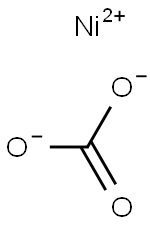
CHEMICAL AND PHYSICAL PROPERTIES
| Physical Description | Dry Powder; Liquid; Other Solid; Water or Solvent Wet Solid |
|---|---|
| Color/Form | Green rhombohedral crystals |
| Melting Point | DECOMPOSES BEFORE REACHING MELTING POINT. |
| Solubility | 93 mg/l water @ 25 °C |
| Density | 4.39 g/cu m |
| Decomposition | Toxic gases and vapors (such as nickel carbonyl) may be released ... in the decomp of nickel cmpd. /Nickel & sol nickel cmpd/ |
| Chemical Classes | Metals -> Nickel Compounds, Inorganic |
SAFETY INFORMATION
| Signal word | Danger |
|---|---|
| Pictogram(s) |
 Exclamation Mark Irritant GHS07  Health Hazard GHS08  Environment GHS09 |
| GHS Hazard Statements |
H302:Acute toxicity,oral H315:Skin corrosion/irritation H317:Sensitisation, Skin H332:Acute toxicity,inhalation H334:Sensitisation, respiratory H341:Germ cell mutagenicity H350:Carcinogenicity H360:Reproductive toxicity H372:Specific target organ toxicity, repeated exposure H400:Hazardous to the aquatic environment, acute hazard H410:Hazardous to the aquatic environment, long-term hazard |
| Precautionary Statement Codes |
P201:Obtain special instructions before use. P260:Do not breathe dust/fume/gas/mist/vapours/spray. P280:Wear protective gloves/protective clothing/eye protection/face protection. P284:Wear respiratory protection. P405:Store locked up. |
COMPUTED DESCRIPTORS
| Molecular Weight | 118.702 g/mol |
|---|---|
| Hydrogen Bond Donor Count | 0 |
| Hydrogen Bond Acceptor Count | 3 |
| Rotatable Bond Count | 0 |
| Exact Mass | 117.920086 g/mol |
| Monoisotopic Mass | 117.920086 g/mol |
| Topological Polar Surface Area | 63.2 Ų |
| Heavy Atom Count | 5 |
| Formal Charge | 0 |
| Complexity | 18.8 |
| Isotope Atom Count | 0 |
| Defined Atom Stereocenter Count | 0 |
| Undefined Atom Stereocenter Count | 0 |
| Defined Bond Stereocenter Count | 0 |
| Undefined Bond Stereocenter Count | 0 |
| Covalently-Bonded Unit Count | 2 |
| Compound Is Canonicalized | Yes |
PRODUCT INTRODUCTION
description
Nickel Carbonate is a light green, crystalline inorganic compound that produces toxic gases upon heating. Nickel carbonate is used in electroplating, to prepare nickel monoxide, to make colored glass and as a catalyst in the treatment of wastewater. Exposure to this substance can cause severe dermatitis, skin and asthma-like allergies and affects the lungs, kidneys, gastrointestinal tract and neurological system. Nickel carbonate is a known carcinogen and is associated with an increased risk of developing lung and nasal cancers. (NCI05)