
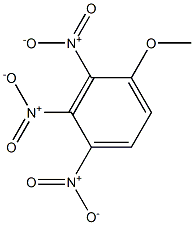
CHEMICAL AND PHYSICAL PROPERTIES
| Physical Description | Trinitroanisole appears as a crystalline structure. Highly toxic. May explode under exposure to intense heat or fire. Primary hazard is blast of an instantaneous explosion, not flying projectiles or fragments. |
|---|---|
| Color/Form | Crystals |
| Melting Point | 67.6 °C |
| Solubility | In water, 200 mg/L at 15 °C, 1368 mg/L at 50 °C |
| Density | 1.408 at 20/4 °C |
| Vapor Pressure | 5.5X10⁻⁶ mm Hg at 25 deg (extrapolated from measurements at higher temperatures in the solid phase via Antoine equation) |
| Decomposition | When heated to decomposition it emits toxic vapors of NOx. |
| Corrosivity | Does not attack metals provided it is protected from moisture. |
| Heat of Vaporization | 91.9 kJ/mol (342-363 K) |
| Other Experimental Properties | Explodes by heat or shock |
COMPUTED DESCRIPTORS
| Molecular Weight | 243.13 g/mol |
|---|---|
| XLogP3 | 0.7 |
| Hydrogen Bond Donor Count | 0 |
| Hydrogen Bond Acceptor Count | 7 |
| Rotatable Bond Count | 1 |
| Exact Mass | 243.01274951 g/mol |
| Monoisotopic Mass | 243.01274951 g/mol |
| Topological Polar Surface Area | 147 Ų |
| Heavy Atom Count | 17 |
| Formal Charge | 0 |
| Complexity | 306 |
| Isotope Atom Count | 0 |
| Defined Atom Stereocenter Count | 0 |
| Undefined Atom Stereocenter Count | 0 |
| Defined Bond Stereocenter Count | 0 |
| Undefined Bond Stereocenter Count | 0 |
| Covalently-Bonded Unit Count | 1 |
| Compound Is Canonicalized | Yes |
PRODUCT INTRODUCTION
description
Trinitroanisole appears as a crystalline structure. Highly toxic. May explode under exposure to intense heat or fire. Primary hazard is blast of an instantaneous explosion, not flying projectiles or fragments.