
284490-13-7
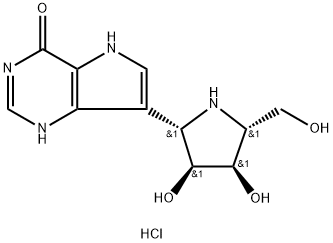
Product Name:
4H-Pyrrolo3,2-dpyrimidin-4-one, 7-(2S,3S,4R,5R)-3,4-dihydroxy-5-(hydroxymethyl)-2-pyrrolidinyl-1,5-dihydro-, monohydrochloride
Formula:
C11H15ClN4O4
Synonyms:
7-[(2S,3S,4R,5R)-3,4-Dihydroxy-5-(hydroxymethyl)-2-pyrrolidinyl]-3,5-dihydro-4H-pyrrolo[3,2-d]pyrimidin-4-one, hydrochloride salt;BCX-1777 HCl;ImmH HCl;Immucillin-H HCl
Inquiry
SAFETY INFORMATION
| Signal word | Danger |
|---|---|
| Pictogram(s) |
 Skull and Crossbones Acute Toxicity GHS06 |
| GHS Hazard Statements |
H301:Acute toxicity,oral |
| Precautionary Statement Codes |
P264:Wash hands thoroughly after handling. P264:Wash skin thouroughly after handling. P270:Do not eat, drink or smoke when using this product. P301+P310:IF SWALLOWED: Immediately call a POISON CENTER or doctor/physician. P405:Store locked up. P501:Dispose of contents/container to..… |
COMPUTED DESCRIPTORS
| Molecular Weight | 302.71 g/mol |
|---|---|
| Hydrogen Bond Donor Count | 7 |
| Hydrogen Bond Acceptor Count | 6 |
| Rotatable Bond Count | 2 |
| Exact Mass | 302.0781827 g/mol |
| Monoisotopic Mass | 302.0781827 g/mol |
| Topological Polar Surface Area | 130 Ų |
| Heavy Atom Count | 20 |
| Formal Charge | 0 |
| Complexity | 404 |
| Isotope Atom Count | 0 |
| Defined Atom Stereocenter Count | 4 |
| Undefined Atom Stereocenter Count | 0 |
| Defined Bond Stereocenter Count | 0 |
| Undefined Bond Stereocenter Count | 0 |
| Covalently-Bonded Unit Count | 2 |
| Compound Is Canonicalized | Yes |
PRODUCT INTRODUCTION
description
Forodesine Hydrochloride is the hydrochloride salt of the synthetic high-affinity transition-state analogue forodesine. Forodesine binds preferentially to and inhibits purine nucleotide phosphorylase (PNP), resulting in the accumulation of deoxyguanosine triphosphate and the subsequent inhibition of the enzyme ribonucleoside diphosphate reductase and DNA synthesis. This agent selectively causes apoptosis in stimulated or malignant T-lymphocytes. A transition state analogue is a substrate designed to mimic the properties or the geometry of the transition state of reaction.