
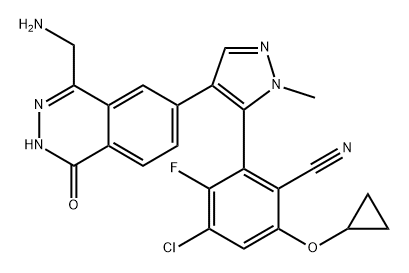
COMPUTED DESCRIPTORS
| Molecular Weight | 464.9 g/mol |
|---|---|
| XLogP3 | 2.7 |
| Hydrogen Bond Donor Count | 2 |
| Hydrogen Bond Acceptor Count | 7 |
| Rotatable Bond Count | 5 |
| Exact Mass | 464.1163797 g/mol |
| Monoisotopic Mass | 464.1163797 g/mol |
| Topological Polar Surface Area | 118 Ų |
| Heavy Atom Count | 33 |
| Formal Charge | 0 |
| Complexity | 846 |
| Isotope Atom Count | 0 |
| Defined Atom Stereocenter Count | 0 |
| Undefined Atom Stereocenter Count | 0 |
| Defined Bond Stereocenter Count | 0 |
| Undefined Bond Stereocenter Count | 0 |
| Covalently-Bonded Unit Count | 1 |
| Compound Is Canonicalized | Yes |
PRODUCT INTRODUCTION
description
PRMT5-MTA Inhibitor MRTX1719 is an orally bioavailable inhibitor of the protein arginine methyltransferase 5 (PRMT5)-methylthioadenosine (MTA) complex, with potential antineoplastic activity. Upon oral administration, PRMT5-MTA inhibitor MRTX1719 selectively binds to the PRMT5-MTA complex that is elevated in methylthioadenosine phosphoylase (MTAP)-deleted cancer cells, thereby specifically inhibiting the function of PRMT5 solely within MTAP-deleted cancer cells and not in normal, healthy cells. By inhibiting the methyltransferase activity of PRMT5, levels of both monomethylated and dimethylated arginine residues in histones H2A, H3 and H4 are decreased. This modulates the expression of genes involved in several cellular processes, including cellular proliferation. This may increase the expression of antiproliferative genes and/or decrease the expression of genes that promote cell proliferation, which may lead to decreased growth of rapidly proliferating cancer cells. MRTX1719 also causes dysregulated RNA splicing and decreased pRb. Together, this decreases proliferation and increases apoptosis specifically in MTAP-deleted cancer cells. PRMT5, a type II methyltransferase that catalyzes the formation of both omega-N monomethylarginine (MMA) and symmetric dimethylarginine (sDMA) on histones and a variety of other protein substrates involved in signal transduction and cellular transcription, is essential for the viability of cancer and normal cells. It is overexpressed in several neoplasms. Elevated levels are associated with decreased patient survival. MTAP is deleted in certain cancer cells leading to an accumulation of the metabolite MTA; MTA binds to and partially inhibits the activity of PRMT5.