
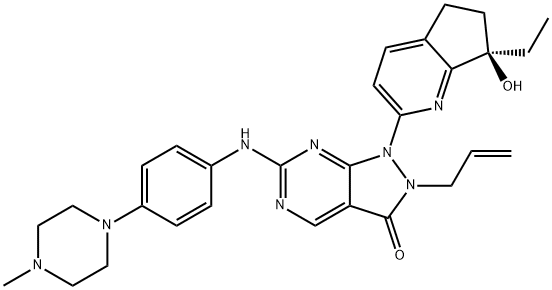
COMPUTED DESCRIPTORS
| Molecular Weight | 526.6 g/mol |
|---|---|
| XLogP3 | 3.7 |
| Hydrogen Bond Donor Count | 2 |
| Hydrogen Bond Acceptor Count | 9 |
| Rotatable Bond Count | 7 |
| Exact Mass | 526.28047236 g/mol |
| Monoisotopic Mass | 526.28047236 g/mol |
| Topological Polar Surface Area | 101 Ų |
| Heavy Atom Count | 39 |
| Formal Charge | 0 |
| Complexity | 875 |
| Isotope Atom Count | 0 |
| Defined Atom Stereocenter Count | 1 |
| Undefined Atom Stereocenter Count | 0 |
| Defined Bond Stereocenter Count | 0 |
| Undefined Bond Stereocenter Count | 0 |
| Covalently-Bonded Unit Count | 1 |
| Compound Is Canonicalized | Yes |
PRODUCT INTRODUCTION
description
Azenosertib is an inhibitor of the tyrosine kinase Wee1 (Wee1-like protein kinase; Wee1A kinase; WEE1hu) with potential antineoplastic sensitizing activity. Although the exact mechanism of action by which this agent inhibits Wee1 has yet to be disclosed, upon administration of ZN-c3, this agent targets and inhibits Wee1. Inhibition of Wee1 promotes both premature mitosis and a prolonged mitotic arrest leading to cell death in susceptible tumor cells, such as p53-deficient or mutated human cancers that lack the G1 checkpoint, upon treatment with DNA-damaging chemotherapeutic agents. Unlike normal cells, most p53-deficient or mutated human cancers lack the G1 checkpoint as p53 is the key regulator of the G1 checkpoint and these cells rely on the G2 checkpoint for DNA repair to damaged cells. Annulment of the G2 checkpoint may therefore make p53-deficient tumor cells more vulnerable to antineoplastic agents and enhance their cytotoxic effect. Overexpression of Wee1 occurs in several cancer types and high expression of Wee1 is associated with poor outcomes. Wee1 phosphorylates Cdc2 in the Cdc2/cyclin B (CDK1/cyclin B) complex which blocks progression from G2 into mitosis; it negatively regulates the G2 checkpoint by disallowing entry into mitosis in response to DNA damage.