
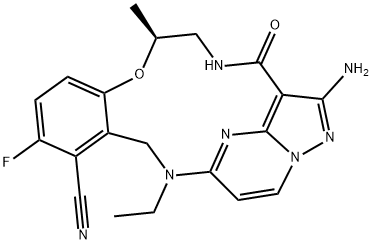
COMPUTED DESCRIPTORS
| Molecular Weight | 409.4 g/mol |
|---|---|
| XLogP3 | 2.1 |
| Hydrogen Bond Donor Count | 2 |
| Hydrogen Bond Acceptor Count | 8 |
| Rotatable Bond Count | 1 |
| Exact Mass | 409.16625107 g/mol |
| Monoisotopic Mass | 409.16625107 g/mol |
| Topological Polar Surface Area | 122 Ų |
| Heavy Atom Count | 30 |
| Formal Charge | 0 |
| Complexity | 687 |
| Isotope Atom Count | 0 |
| Defined Atom Stereocenter Count | 1 |
| Undefined Atom Stereocenter Count | 0 |
| Defined Bond Stereocenter Count | 0 |
| Undefined Bond Stereocenter Count | 0 |
| Covalently-Bonded Unit Count | 1 |
| Compound Is Canonicalized | Yes |
PRODUCT INTRODUCTION
description
Elzovantinib is an orally bioavailable, multi-targeted kinase inhibitor with potential antineoplastic activity. Upon oral administration, elzovantinib binds to and inhibits three tyrosine kinases that are often overexpressed in a variety of cancer cell types, including MET (c-Met; hepatocyte growth factor receptor; HGFR) , Src, and colony stimulating factor 1 receptor (CSF1R; CSF-1R; C-FMS; CD115; macrophage colony-stimulating factor receptor; M-CSFR) thereby disrupting their respective signaling pathways. MET, a receptor tyrosine kinase overexpressed or mutated in many tumor cell types, plays an important role in tumor cell proliferation, survival, invasion, and metastasis, and in tumor angiogenesis. Src, a non-receptor tyrosine kinase upregulated in many tumor cell types, plays an important role in tumor cell proliferation, motility, invasiveness and survival. CSF1R is a cell-surface receptor for colony stimulating factor 1 (CSF1); this receptor tyrosine kinase is overexpressed by tumor-associated macrophages (TAMs) in the tumor microenvironment (TME), and plays a major role in both immune suppression and the induction of tumor cell proliferation.