
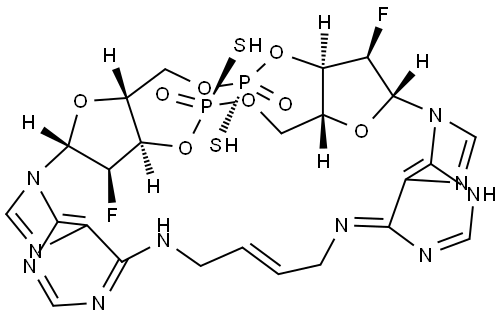
COMPUTED DESCRIPTORS
| Molecular Weight | 746.6 g/mol |
|---|---|
| XLogP3 | 1.2 |
| Hydrogen Bond Donor Count | 4 |
| Hydrogen Bond Acceptor Count | 20 |
| Rotatable Bond Count | 0 |
| Exact Mass | 746.08198049 g/mol |
| Monoisotopic Mass | 746.08198049 g/mol |
| Topological Polar Surface Area | 237 Ų |
| Heavy Atom Count | 48 |
| Formal Charge | 0 |
| Complexity | 1330 |
| Isotope Atom Count | 0 |
| Defined Atom Stereocenter Count | 8 |
| Undefined Atom Stereocenter Count | 0 |
| Defined Bond Stereocenter Count | 1 |
| Undefined Bond Stereocenter Count | 0 |
| Covalently-Bonded Unit Count | 1 |
| Compound Is Canonicalized | Yes |
PRODUCT INTRODUCTION
description
Macrocycle-bridged STING Agonist E7766 is an agonist of macrocycle-bridged stimulator of interferon genes (STING) protein, with potential immunoactivating and antineoplastic activities. Upon intravenous administration, macrocycle-bridged STING agonist (MBSA) E7766 targets and binds to STING and activates the STING pathway, which promotes IKK-related kinase TANK-binding kinase 1 (TBK1) signaling and activates nuclear factor-kappa B (NF-kB) and interferon regulatory factor 3 (IRF3) in immune cells in the tumor microenvironment (TME). This leads to the production of pro-inflammatory cytokines, including interferons (IFNs). Specifically, expression of IFN-beta (IFNb) enhances the cross-presentation of tumor-associated antigens (TAAs) by CD8alpha-positive and CD103-positive dendritic cells (DCs) to cytotoxic T-lymphocytes (CTLs). This results in a CTL-mediated immune response against tumor cells and causes tumor cell lysis. Compared to conventional STING agonists, MBSA E7766 allows for conformational rigidity of the unique macrocycle bridge which enhances its stability and STING affinity, thereby increasing its efficacy.