
SAFETY INFORMATION
| Signal word | Warning |
|---|---|
| Pictogram(s) |
 Exclamation Mark Irritant GHS07 |
| GHS Hazard Statements |
H302:Acute toxicity,oral H315:Skin corrosion/irritation H319:Serious eye damage/eye irritation H335:Specific target organ toxicity, single exposure;Respiratory tract irritation |
| Precautionary Statement Codes |
P261:Avoid breathing dust/fume/gas/mist/vapours/spray. P305+P351+P338:IF IN EYES: Rinse cautiously with water for several minutes. Remove contact lenses, if present and easy to do. Continuerinsing. |
COMPUTED DESCRIPTORS
| Molecular Weight | 477.6 g/mol |
|---|---|
| XLogP3 | 4.2 |
| Hydrogen Bond Donor Count | 0 |
| Hydrogen Bond Acceptor Count | 6 |
| Rotatable Bond Count | 7 |
| Exact Mass | 477.25400344 g/mol |
| Monoisotopic Mass | 477.25400344 g/mol |
| Topological Polar Surface Area | 61.8 Ų |
| Heavy Atom Count | 35 |
| Formal Charge | 0 |
| Complexity | 720 |
| Isotope Atom Count | 0 |
| Defined Atom Stereocenter Count | 0 |
| Undefined Atom Stereocenter Count | 0 |
| Defined Bond Stereocenter Count | 0 |
| Undefined Bond Stereocenter Count | 0 |
| Covalently-Bonded Unit Count | 1 |
| Compound Is Canonicalized | Yes |
PRODUCT INTRODUCTION
description
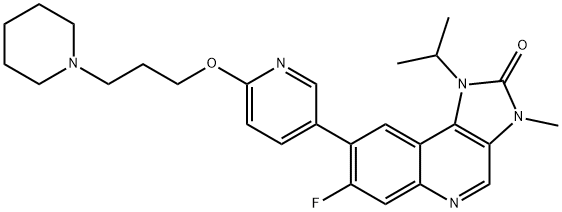
ATM Kinase Inhibitor AZD1390 is an orally bioavailable inhibitor of ataxia telangiectasia mutated (ATM) kinase, with potential antineoplastic activity. Upon oral administration, AZD1390 targets and binds to ATM, thereby inhibiting the kinase activity of ATM and ATM-mediated signaling. This prevents DNA damage checkpoint activation, disrupts DNA damage repair, induces tumor cell apoptosis, and leads to cell death in ATM-overexpressing tumor cells. AZD1390 hypersensitizes tumors to chemo/radiotherapy. In addition, AZD1390 is able to cross the blood-brain barrier (BBB). ATM, a serine/threonine protein kinase belonging to the phosphatidylinositol 3-kinase-related kinase (PIKK) family of protein kinases, is upregulated in a variety of cancer cell types. It is activated in response to DNA double-strand breaks (DSB) and plays a key role in DNA repair.