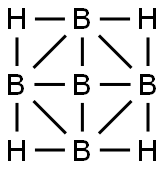
| Physical Description |
Pentaborane appears as a clear colorless liquid with a pungent odor like sour milk. Freezing point -52.9 °F (-46.6 °C). Boiling point 136.4 °F (58 °C). Decomposition temperature 302 °F (150 °C). Vapors toxic both under prolonged exposure to low concentrations and short exposure to high concentrations. Density 0.61 g / cm3. Under prolonged exposure to intense heat the containers may rupture violently and rocket. |
| Color/Form |
Colorless liquid. |
| Odor |
Strong, pungent, foul |
| Boiling Point |
140 °F at 760 mmHg (EPA, 1998) |
| Melting Point |
-51.9 °F (EPA, 1998) |
| Flash Point |
86 °F (EPA, 1998) |
| Solubility |
Reacts with water (NIOSH, 2023) |
| Density |
0.61 at 32 °F (EPA, 1998) - Less dense than water; will float |
| Vapor Density |
2.2 |
| Vapor Pressure |
171 mmHg at 68 °F (EPA, 1998) |
| Stability/Shelf Life |
Conditions contributing to instability: Temperatures above 150 °C (302 F) cause decomposition and pressure buildup in containers. |
| Autoignition Temperature |
Spontaneously flammable if impure. Approx. 35 °C when pure. (USCG, 1999) |
| Decomposition |
Decomposes above 300 °F (149 °C) if it is not already ignited. |
| Viscosity |
0.319 centipoise at 70 °F |
| Corrosivity |
Corrosive to natural rubber, some synthetic rubber, some greases, and some lubricants |
| Heat of Combustion |
-29,100 BTU/lb = -16,200 cal/g = -677X10+5 J/kg |
| Heat of Vaporization |
219 BTU/lb = 122 cal/g = 5.10X10+5 J/kg |
| Surface Tension |
20.8 dynes/cm = 0.0208 N/m at 25 °C |
| Ionization Potential |
9.90 eV |
| Odor Threshold |
Odor Threshold Low: 0.97 [mmHg] Odor threshold from AIHA |
| Other Experimental Properties |
Standard enthalpy of formation: 42.7 kJ/mol (liquid); 73.2 kJ/mol (gas); molar heat capacity at 25 °C: 151.1 J/mol K (liquid); 99.6 J/mol K (gas) |
| Chemical Classes |
Toxic Gases & Vapors -> Hydrides |