
16676-29-2
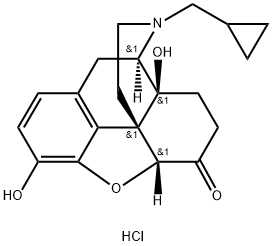
Product Name:
Naltrexone hydrochloride
Formula:
C20H24ClNO4
Synonyms:
Naltrexone HCl
Inquiry
CHEMICAL AND PHYSICAL PROPERTIES
| Solubility | >56.7 [ug/mL] (The mean of the results at pH 7.4) |
|---|---|
| Collision Cross Section | 176 Ų [M+H]+ [CCS Type: TW, Method: calibrated with polyalanine and drug standards] |
SAFETY INFORMATION
| Signal word | Warning |
|---|---|
| Pictogram(s) |
 Exclamation Mark Irritant GHS07 |
| GHS Hazard Statements |
H302:Acute toxicity,oral |
COMPUTED DESCRIPTORS
| Molecular Weight | 377.9 g/mol |
|---|---|
| Hydrogen Bond Donor Count | 3 |
| Hydrogen Bond Acceptor Count | 5 |
| Rotatable Bond Count | 2 |
| Exact Mass | 377.1393859 g/mol |
| Monoisotopic Mass | 377.1393859 g/mol |
| Topological Polar Surface Area | 70 Ų |
| Heavy Atom Count | 26 |
| Formal Charge | 0 |
| Complexity | 621 |
| Isotope Atom Count | 0 |
| Defined Atom Stereocenter Count | 4 |
| Undefined Atom Stereocenter Count | 0 |
| Defined Bond Stereocenter Count | 0 |
| Undefined Bond Stereocenter Count | 0 |
| Covalently-Bonded Unit Count | 2 |
| Compound Is Canonicalized | Yes |
PRODUCT INTRODUCTION
description
Naltrexone hydrochloride is a hydrochloride obtained by reaction of oxycodone with one molar equivalent of hydrochloric acid. it is a mu-opioid receptor antagonist that is used to treat alcohol dependence. It has a role as a mu-opioid receptor antagonist, an antidote to opioid poisoning and a central nervous system depressant. It contains a naltrexone(1+).