
157622-02-1
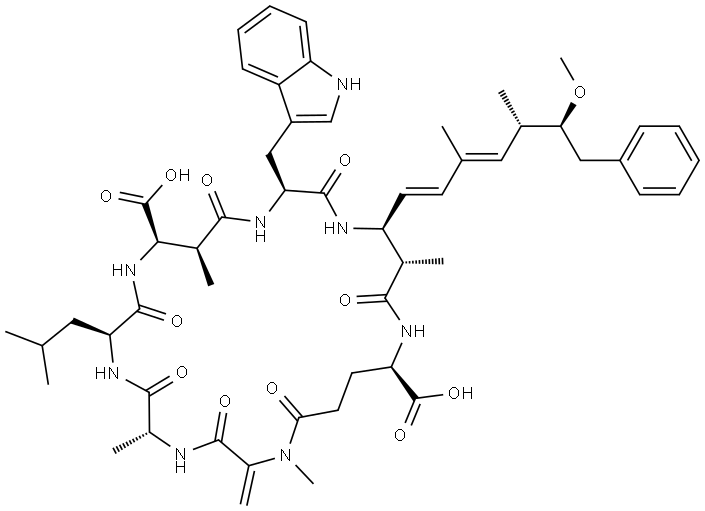
Product Name:
Algae bloom toxin, Biotoxin, Cyanobacterial toxin
Formula:
C54H72N8O12
Inquiry
SAFETY INFORMATION
| Signal word | Danger |
|---|---|
| Pictogram(s) |
 Flame Flammables GHS02  Skull and Crossbones Acute Toxicity GHS06  Health Hazard GHS08 |
| GHS Hazard Statements |
H225:Flammable liquids H301:Acute toxicity,oral H311:Acute toxicity,dermal H330:Acute toxicity,inhalation H334:Sensitisation, respiratory H370:Specific target organ toxicity, single exposure |
| Precautionary Statement Codes |
P210:Keep away from heat/sparks/open flames/hot surfaces. — No smoking. P260:Do not breathe dust/fume/gas/mist/vapours/spray. P280:Wear protective gloves/protective clothing/eye protection/face protection. P284:Wear respiratory protection. P310:Immediately call a POISON CENTER or doctor/physician. P301+P310:IF SWALLOWED: Immediately call a POISON CENTER or doctor/physician. |
COMPUTED DESCRIPTORS
| Molecular Weight | 1025.2 g/mol |
|---|---|
| XLogP3 | 5.2 |
| Hydrogen Bond Donor Count | 9 |
| Hydrogen Bond Acceptor Count | 12 |
| Rotatable Bond Count | 13 |
| Exact Mass | 1024.52696976 g/mol |
| Monoisotopic Mass | 1024.52696976 g/mol |
| Topological Polar Surface Area | 295 Ų |
| Heavy Atom Count | 74 |
| Formal Charge | 0 |
| Complexity | 2090 |
| Isotope Atom Count | 0 |
| Defined Atom Stereocenter Count | 0 |
| Undefined Atom Stereocenter Count | 10 |
| Defined Bond Stereocenter Count | 2 |
| Undefined Bond Stereocenter Count | 0 |
| Covalently-Bonded Unit Count | 1 |
| Compound Is Canonicalized | Yes |
PRODUCT INTRODUCTION
description
Microcystin-LF is analog of Microcystin-LR with Phe substituted in place of Arg. It is believed to be more cell-permeable than other microcystins. Microcystins (also known as cyanoginosins) are a class of toxins produced by certain freshwater cyanobacteria. Microcystins are chemically stable over a wide range of temperature and pH, possibly as a result of their cyclic structure. The toxins are also resistant to enzymatic hydrolysis (in guts of animals) by some general proteases, such as pepsin, trypsin, collagenase, and chymotrypsin.