
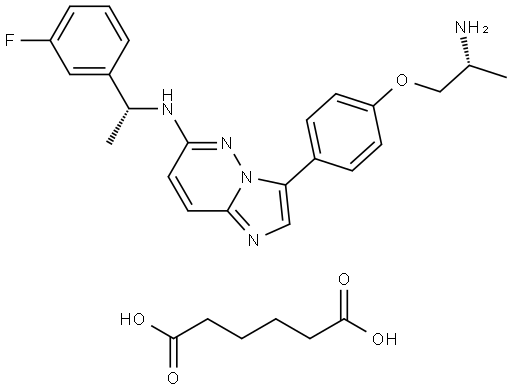
SAFETY INFORMATION
| Signal word | Warning |
|---|---|
| Pictogram(s) |
 Exclamation Mark Irritant GHS07 |
| GHS Hazard Statements |
H302:Acute toxicity,oral H315:Skin corrosion/irritation H319:Serious eye damage/eye irritation H335:Specific target organ toxicity, single exposure;Respiratory tract irritation |
| Precautionary Statement Codes |
P261:Avoid breathing dust/fume/gas/mist/vapours/spray. P280:Wear protective gloves/protective clothing/eye protection/face protection. P301+P312:IF SWALLOWED: call a POISON CENTER or doctor/physician IF you feel unwell. P302+P352:IF ON SKIN: wash with plenty of soap and water. P305+P351+P338:IF IN EYES: Rinse cautiously with water for several minutes. Remove contact lenses, if present and easy to do. Continuerinsing. |
COMPUTED DESCRIPTORS
| Molecular Weight | 551.6 g/mol |
|---|---|
| Hydrogen Bond Donor Count | 4 |
| Hydrogen Bond Acceptor Count | 10 |
| Rotatable Bond Count | 12 |
| Exact Mass | 551.25439736 g/mol |
| Monoisotopic Mass | 551.25439736 g/mol |
| Topological Polar Surface Area | 152 Ų |
| Heavy Atom Count | 40 |
| Formal Charge | 0 |
| Complexity | 645 |
| Isotope Atom Count | 0 |
| Defined Atom Stereocenter Count | 2 |
| Undefined Atom Stereocenter Count | 0 |
| Defined Bond Stereocenter Count | 0 |
| Undefined Bond Stereocenter Count | 0 |
| Covalently-Bonded Unit Count | 2 |
| Compound Is Canonicalized | Yes |
PRODUCT INTRODUCTION
description
Taletrectinib Adipate is the adiptate form of taletrectinib, a n orally available inhibitor of the receptor tyrosine kinases C-ros oncogene 1 (ROS1) and the neurotrophic tyrosine receptor kinase (NTRK) types 1, 2 and 3, with potential antineoplastic activity. Upon oral administration, taletrectinib binds to and inhibits ROS1 and the NTRK family members. This inhibition leads to a disruption of ROS1- and NTRK-mediated signaling and eventually inhibits the growth of tumor cells that are overexpressing ROS1 and/or NTRKs. ROS1, overexpressed in certain cancer cells, plays a key role in cell growth and survival of cancer cells. NTRK mutations or rearrangements play a key role in cancer progression.