
1461-25-2
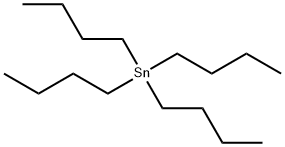
Product Name:
Tetrabutyltin
Formula:
C16H36Sn
Synonyms:
Tetrabutylstannane, Tin tetrabutyl;Tetra-n-butyltin;Tin tetrabutyl
Inquiry
CHEMICAL AND PHYSICAL PROPERTIES
| Physical Description | Liquid |
|---|---|
| Color/Form | Colorless or slightly yellow oily liquid |
| Odor | Distinct, characteristic odor |
| Boiling Point | 145 °C @ 10 mm Hg |
| Melting Point | -97 °C |
| Solubility | Insol in water; sol in most organic solvents |
| Density | 1.054 g/cu cm at 20 °C |
| Vapor Pressure | 0.0048 [mmHg] |
| Stability/Shelf Life | STABLE |
| Decomposition | When heated to decomposition it emits acrid smoke and fumes. |
| Heat of Vaporization | 61.3 kJ/mol |
| Refractive Index | Index of refraction: 1.4727 @ 20 °C |
| Kovats Retention Index | 1588 1593 1594 1599 |
| Other Experimental Properties | The most important reactions which tetraorganic tins undergo are heterolytic, i.e. electrophilic and nucleophilic, cleavage and the Kocheshkov redistribution. The tin-carbon bond in tetraorganic tins is easily cleaved by halogens, hydrogen halides, and mineral acids. /Tetraorganotins/ |
| Chemical Classes | Metals -> Tin Compounds, Organic |
SAFETY INFORMATION
| Signal word | Danger |
|---|---|
| Pictogram(s) |
 Skull and Crossbones Acute Toxicity GHS06  Health Hazard GHS08  Environment GHS09 |
| GHS Hazard Statements |
H301:Acute toxicity,oral H312:Acute toxicity,dermal H315:Skin corrosion/irritation H319:Serious eye damage/eye irritation H372:Specific target organ toxicity, repeated exposure H410:Hazardous to the aquatic environment, long-term hazard |
| Precautionary Statement Codes |
P273:Avoid release to the environment. P280:Wear protective gloves/protective clothing/eye protection/face protection. P314:Get medical advice/attention if you feel unwell. P301+P310:IF SWALLOWED: Immediately call a POISON CENTER or doctor/physician. P305+P351+P338:IF IN EYES: Rinse cautiously with water for several minutes. Remove contact lenses, if present and easy to do. Continuerinsing. |
COMPUTED DESCRIPTORS
| Molecular Weight | 347.2 g/mol |
|---|---|
| Hydrogen Bond Donor Count | 0 |
| Hydrogen Bond Acceptor Count | 0 |
| Rotatable Bond Count | 12 |
| Exact Mass | 348.183904 g/mol |
| Monoisotopic Mass | 348.183904 g/mol |
| Topological Polar Surface Area | 0 Ų |
| Heavy Atom Count | 17 |
| Formal Charge | 0 |
| Complexity | 116 |
| Isotope Atom Count | 0 |
| Defined Atom Stereocenter Count | 0 |
| Undefined Atom Stereocenter Count | 0 |
| Defined Bond Stereocenter Count | 0 |
| Undefined Bond Stereocenter Count | 0 |
| Covalently-Bonded Unit Count | 1 |
| Compound Is Canonicalized | Yes |
PRODUCT INTRODUCTION
description
Tetrabutyltin is an organotin compound. It is the starting material of the tributyltin and dibutyltin compounds, which are used as stabilizers for PVC, biocides, fungicides, and anti-biofouling agents. Tin is a chemical element with the symbol Sn and atomic number 50. It is a natural component of the earth's crust and is obtained chiefly from the mineral cassiterite, where it occurs as tin dioxide. (L307, L309, L314)