
SAFETY INFORMATION
| Signal word | Warning |
|---|---|
| Pictogram(s) |
 Exclamation Mark Irritant GHS07 |
| GHS Hazard Statements |
H302:Acute toxicity,oral H315:Skin corrosion/irritation H319:Serious eye damage/eye irritation H335:Specific target organ toxicity, single exposure;Respiratory tract irritation |
| Precautionary Statement Codes |
P261:Avoid breathing dust/fume/gas/mist/vapours/spray. P305+P351+P338:IF IN EYES: Rinse cautiously with water for several minutes. Remove contact lenses, if present and easy to do. Continuerinsing. |
COMPUTED DESCRIPTORS
| Molecular Weight | 521.4 g/mol |
|---|---|
| XLogP3 | 4.9 |
| Hydrogen Bond Donor Count | 3 |
| Hydrogen Bond Acceptor Count | 7 |
| Rotatable Bond Count | 6 |
| Exact Mass | 520.12224 g/mol |
| Monoisotopic Mass | 520.12224 g/mol |
| Topological Polar Surface Area | 91.4 Ų |
| Heavy Atom Count | 34 |
| Formal Charge | 0 |
| Complexity | 716 |
| Isotope Atom Count | 0 |
| Defined Atom Stereocenter Count | 0 |
| Undefined Atom Stereocenter Count | 0 |
| Defined Bond Stereocenter Count | 0 |
| Undefined Bond Stereocenter Count | 0 |
| Covalently-Bonded Unit Count | 1 |
| Compound Is Canonicalized | Yes |
PRODUCT INTRODUCTION
description
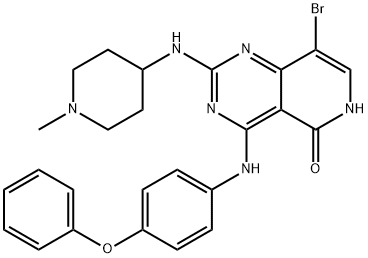
Denfivontinib is an orally bioavailable inhibitor of both wild type and mutant forms of FMS-like tyrosine kinase 3 (FLT3; CD135; STK1; FLK2), with potential antineoplastic activity. Upon administration, denfivontinib binds to and inhibits the activity of FLT3, including FLT3-ITD (internal tandem duplications), FLT3-D835Y as well as other mutants. This inhibits uncontrolled FLT3 signaling and results in the inhibition of proliferation in tumor cells overexpressing FLT3. FLT3, a class III receptor tyrosine kinase (RTK), is overexpressed or mutated in most B lineage neoplasms and in acute myeloid leukemias, and plays a key role in tumor cell proliferation. In addition, denfivontinib also inhibits, to a lesser degree, the receptor tyrosine kinases AXL (UFO), Mer, Ret, vascular endothelial growth factor receptor 1 (VEGFR1), Fms, fibroblast growth factor receptors (FGFR) 1 and 3, and the serine/threonine kinases Aurora B and C.