
COMPUTED DESCRIPTORS
| Molecular Weight | 230.03313 g/mol |
|---|---|
| Hydrogen Bond Donor Count | 0 |
| Hydrogen Bond Acceptor Count | 0 |
| Rotatable Bond Count | 0 |
| Exact Mass | 230.03313 g/mol |
| Monoisotopic Mass | 230.03313 g/mol |
| Topological Polar Surface Area | 0 Ų |
| Heavy Atom Count | 1 |
| Formal Charge | 0 |
| Complexity | 0 |
| Isotope Atom Count | 1 |
| Defined Atom Stereocenter Count | 0 |
| Undefined Atom Stereocenter Count | 0 |
| Defined Bond Stereocenter Count | 0 |
| Undefined Bond Stereocenter Count | 0 |
| Covalently-Bonded Unit Count | 1 |
| Compound Is Canonicalized | Yes |
PRODUCT INTRODUCTION
description
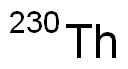
Thorium is the chemical element of symbol Th and atomic number 90. It is a naturally occurring radioactive metal of the actinide series. In the environment, thorium exists in combination with other minerals, such as silica. Small amounts of thorium are present in all rocks, soil, water, plants, and animals. Twenty-seven radioactive isotopes of thorium, with mass number from 210 to 236, have been characterized. Naturally occurring thorium is composed mainly of one isotope: 232Th. The most abundant and/or stable isotopes are: 232Th (half-life of 14.05 billion years), 230Th (half-life of 75,380 years), 229Th (half-life of 7340 years), and 228Th (half-life of 1.92 years). Thorium is used to make ceramics, gas lantern mantles, and metals used in the aerospace industry and in nuclear reactions. Thorium can also be used as a fuel for generating nuclear energy. Thorium has been linked to increased risk of liver cancer. (L1094, L1838)