
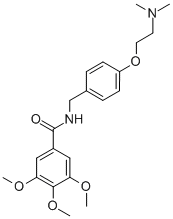
CHEMICAL AND PHYSICAL PROPERTIES
| Physical Description | Solid |
|---|---|
| Melting Point | 188.7 °C |
| Solubility | 40 mg/L |
| LogP | 2.29 |
| Dissociation Constants | 8.78 |
| Kovats Retention Index | 3287 |
| Other Experimental Properties | CRYSTALS; MP: 187.5-190 °C; FREELY SOL IN WATER (MORE THAN 50% @ 25 °C) /HYDROCHLORIDE/ |
COMPUTED DESCRIPTORS
| Molecular Weight | 388.5 g/mol |
|---|---|
| XLogP3 | 2.3 |
| Hydrogen Bond Donor Count | 1 |
| Hydrogen Bond Acceptor Count | 6 |
| Rotatable Bond Count | 10 |
| Exact Mass | 388.19982200 g/mol |
| Monoisotopic Mass | 388.19982200 g/mol |
| Topological Polar Surface Area | 69.3 Ų |
| Heavy Atom Count | 28 |
| Formal Charge | 0 |
| Complexity | 440 |
| Isotope Atom Count | 0 |
| Defined Atom Stereocenter Count | 0 |
| Undefined Atom Stereocenter Count | 0 |
| Defined Bond Stereocenter Count | 0 |
| Undefined Bond Stereocenter Count | 0 |
| Covalently-Bonded Unit Count | 1 |
| Compound Is Canonicalized | Yes |
PRODUCT INTRODUCTION
description
Trimethobenzamide is the amide obtained by formal condensation of 3,4,5-trihydroxybenzoic acid with 4-[2-(N,N-dimethylamino)ethoxy]benzylamine. It is used to prevent nausea and vomitting in humans. It has a role as an antiemetic. It is a tertiary amino compound and a member of benzamides.