
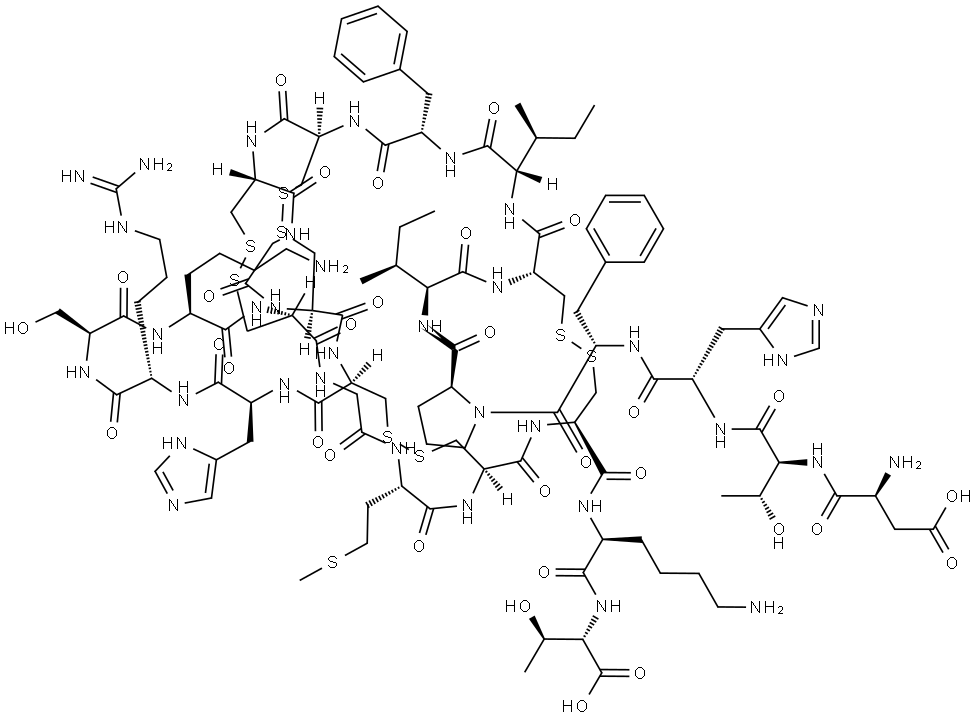
SAFETY INFORMATION
| Signal word | Warning |
|---|---|
| Pictogram(s) |
 Exclamation Mark Irritant GHS07 |
| GHS Hazard Statements |
H315:Skin corrosion/irritation H319:Serious eye damage/eye irritation H335:Specific target organ toxicity, single exposure;Respiratory tract irritation |
| Precautionary Statement Codes |
P280:Wear protective gloves/protective clothing/eye protection/face protection. P302+P352:IF ON SKIN: wash with plenty of soap and water. |
COMPUTED DESCRIPTORS
| Molecular Weight | 2789.4 g/mol |
|---|---|
| XLogP3 | -10.9 |
| Hydrogen Bond Donor Count | 36 |
| Hydrogen Bond Acceptor Count | 46 |
| Rotatable Bond Count | 49 |
| Exact Mass | 2788.0291202 g/mol |
| Monoisotopic Mass | 2787.0257653 g/mol |
| Topological Polar Surface Area | 1250 Ų |
| Heavy Atom Count | 187 |
| Formal Charge | 0 |
| Complexity | 5940 |
| Isotope Atom Count | 0 |
| Defined Atom Stereocenter Count | 27 |
| Undefined Atom Stereocenter Count | 0 |
| Defined Bond Stereocenter Count | 0 |
| Undefined Bond Stereocenter Count | 0 |
| Covalently-Bonded Unit Count | 1 |
| Compound Is Canonicalized | Yes |
PRODUCT INTRODUCTION
description
Forms of hepcidin, a cationic amphipathic peptide synthesized in the liver as a prepropeptide which is first processed into prohepcidin and then into the biologically active hepcidin forms, including in human the 20-, 22-, and 25-amino acid residue peptide forms. Hepcidin acts as a homeostatic regulators of iron metabolism and also possesses antimicrobial activity.