
SAFETY INFORMATION
| Signal word | Warning |
|---|---|
| Pictogram(s) |
 Exclamation Mark Irritant GHS07 |
| GHS Hazard Statements |
H302:Acute toxicity,oral H315:Skin corrosion/irritation H319:Serious eye damage/eye irritation H335:Specific target organ toxicity, single exposure;Respiratory tract irritation |
| Precautionary Statement Codes |
P261:Avoid breathing dust/fume/gas/mist/vapours/spray. P280:Wear protective gloves/protective clothing/eye protection/face protection. P301+P312:IF SWALLOWED: call a POISON CENTER or doctor/physician IF you feel unwell. P302+P352:IF ON SKIN: wash with plenty of soap and water. P305+P351+P338:IF IN EYES: Rinse cautiously with water for several minutes. Remove contact lenses, if present and easy to do. Continuerinsing. |
COMPUTED DESCRIPTORS
| Molecular Weight | 568.6 g/mol |
|---|---|
| XLogP3 | 2.2 |
| Hydrogen Bond Donor Count | 3 |
| Hydrogen Bond Acceptor Count | 10 |
| Rotatable Bond Count | 7 |
| Exact Mass | 568.24097336 g/mol |
| Monoisotopic Mass | 568.24097336 g/mol |
| Topological Polar Surface Area | 120 Ų |
| Heavy Atom Count | 41 |
| Formal Charge | 0 |
| Complexity | 894 |
| Isotope Atom Count | 0 |
| Defined Atom Stereocenter Count | 1 |
| Undefined Atom Stereocenter Count | 0 |
| Defined Bond Stereocenter Count | 0 |
| Undefined Bond Stereocenter Count | 0 |
| Covalently-Bonded Unit Count | 1 |
| Compound Is Canonicalized | Yes |
PRODUCT INTRODUCTION
description
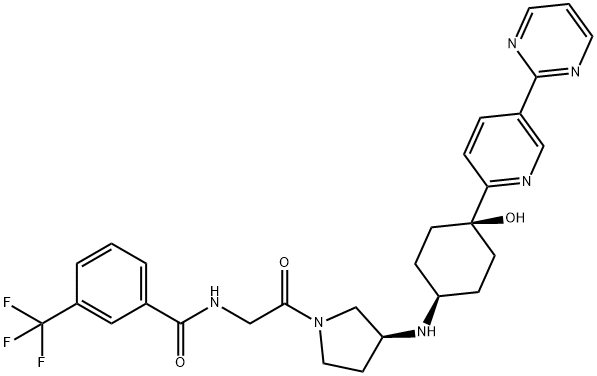
CCR2 Antagonist PF-04136309 is an orally available human chemokine receptor 2 (CCR2) antagonist with potential immunomodulating and antineoplastic activities. Upon oral administration, CCR2 antagonist PF-04136309 specifically binds to CCR2 and prevents binding of the endothelium-derived chemokine ligand CLL2 (monocyte chemoattractant protein-1 or MCP1) to its receptor CCR2, which may result in inhibition of CCR2 activation and signal transduction. This may inhibit inflammatory processes as well as angiogenesis, tumor cell migration, and tumor cell proliferation. The G-protein coupled receptor CCR2 is expressed on the surface of monocytes and macrophages, stimulates the migration and infiltration of these cell types, and plays an important role in inflammation, angiogenesis, and tumor cell migration and proliferation.