
125-40-6
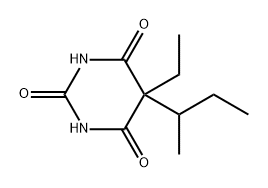
Product Name:
BUTABARBITAL
Formula:
C10H16N2O3
Synonyms:
5-Ethyl-5-(1-methylpropyl)-2,4,6(1H,3H,5H)-pyrimidinetrione;Secbutobarbitone
Inquiry
CHEMICAL AND PHYSICAL PROPERTIES
| Physical Description | Solid |
|---|---|
| Color/Form | Fine, white, microcrystalline powder |
| Odor | Odorless |
| Taste | Bitter |
| Melting Point | 166.5 °C |
| Solubility | WHITE POWDER; PRACTICALLY INSOL IN BENZENE & ABS ETHER /SODIUM SALT/ |
| LogP | 1.65 |
| Stability/Shelf Life | Sodium salts of barbiturates dissolve in water, forming alkaline solutions which are often unstable /Sodium salts/ |
| Decomposition | When heated to decomp it emits toxic fumes of oxides of /nitric oxide/. |
| Refractive Index | INDEX OF REFRACTION: 1.465 (ALPHA); 1.529 (BETA); 1.532 (GAMMA) /SODIUM SALT/ |
| Kovats Retention Index | 1669 1634 1630 1634 1660 1655 1655 1637 1650 1660 1635 1662.4 1624 1640 1662 1660 1660 |
| Other Experimental Properties | Bitter powder; pH (1% aq soln): from 9.0-10.2; 1 g dissolves in 2 mL water, in about 7 mL alcohol; practically insoluble in ether, benzene /Butabarbital sodium salt/ |
SAFETY INFORMATION
| Signal word | Danger |
|---|---|
| Pictogram(s) |
 Skull and Crossbones Acute Toxicity GHS06 |
| GHS Hazard Statements |
H301:Acute toxicity,oral |
COMPUTED DESCRIPTORS
| Molecular Weight | 212.25 g/mol |
|---|---|
| XLogP3 | 1.6 |
| Hydrogen Bond Donor Count | 2 |
| Hydrogen Bond Acceptor Count | 3 |
| Rotatable Bond Count | 3 |
| Exact Mass | 212.11609238 g/mol |
| Monoisotopic Mass | 212.11609238 g/mol |
| Topological Polar Surface Area | 75.3 Ų |
| Heavy Atom Count | 15 |
| Formal Charge | 0 |
| Complexity | 292 |
| Isotope Atom Count | 0 |
| Defined Atom Stereocenter Count | 0 |
| Undefined Atom Stereocenter Count | 1 |
| Defined Bond Stereocenter Count | 0 |
| Undefined Bond Stereocenter Count | 0 |
| Covalently-Bonded Unit Count | 1 |
| Compound Is Canonicalized | Yes |
PRODUCT INTRODUCTION
description
Butabarbital is a member of barbiturates.