
113-52-0
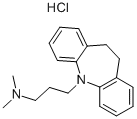
Product Name:
Imipramine hydrochloride
Formula:
C19H25ClN2
Synonyms:
10,11-Dihydro-N,N-dimethyl-5H-dibenz[b,f]azepine-5-propanamine hydrochloride;5-[3-(Dimethylamino)propyl]-10,11-dihydro-5H-dibenz[b,f]azepine hydrochloride;IMI;Imipramine hydrochloride
Inquiry
CHEMICAL AND PHYSICAL PROPERTIES
| Solubility | >47.5 [ug/mL] (The mean of the results at pH 7.4) |
|---|---|
| Collision Cross Section | 165.1 Ų [M+H]+ [CCS Type: TW, Method: calibrated with polyalanine and drug standards] |
SAFETY INFORMATION
| Signal word | Danger |
|---|---|
| Pictogram(s) |
 Skull and Crossbones Acute Toxicity GHS06 |
| GHS Hazard Statements |
H300:Acute toxicity,oral |
| Precautionary Statement Codes |
P264:Wash hands thoroughly after handling. P264:Wash skin thouroughly after handling. P270:Do not eat, drink or smoke when using this product. P301+P310:IF SWALLOWED: Immediately call a POISON CENTER or doctor/physician. P405:Store locked up. P501:Dispose of contents/container to..… |
COMPUTED DESCRIPTORS
| Molecular Weight | 316.9 g/mol |
|---|---|
| Hydrogen Bond Donor Count | 1 |
| Hydrogen Bond Acceptor Count | 2 |
| Rotatable Bond Count | 4 |
| Exact Mass | 316.1706265 g/mol |
| Monoisotopic Mass | 316.1706265 g/mol |
| Topological Polar Surface Area | 6.5 Ų |
| Heavy Atom Count | 22 |
| Formal Charge | 0 |
| Complexity | 291 |
| Isotope Atom Count | 0 |
| Defined Atom Stereocenter Count | 0 |
| Undefined Atom Stereocenter Count | 0 |
| Defined Bond Stereocenter Count | 0 |
| Undefined Bond Stereocenter Count | 0 |
| Covalently-Bonded Unit Count | 2 |
| Compound Is Canonicalized | Yes |
PRODUCT INTRODUCTION
description
Imipramine Hydrochloride is the hydrochloride salt form of imipramine, a synthetic tricyclic derivative, antidepressant Imipramine enhances monoamine neurotransmission in certain areas of the brain. It also induces sedation through histamine 1 receptor blockage; hypotension through beta-adrenergic blockage; and diverse parasympatholytic effects. Imipramine has less sedative effect than other members of its therapeutic family. It is used in major depression, dysthymia, bipolar depression, attention-deficit disorders, agoraphobia, and panic disorders. (NCI04)