
SAFETY INFORMATION
| Signal word | Warning |
|---|---|
| Pictogram(s) |
 Exclamation Mark Irritant GHS07 |
| GHS Hazard Statements |
H302:Acute toxicity,oral H315:Skin corrosion/irritation H319:Serious eye damage/eye irritation H335:Specific target organ toxicity, single exposure;Respiratory tract irritation |
| Precautionary Statement Codes |
P261:Avoid breathing dust/fume/gas/mist/vapours/spray. P305+P351+P338:IF IN EYES: Rinse cautiously with water for several minutes. Remove contact lenses, if present and easy to do. Continuerinsing. |
COMPUTED DESCRIPTORS
| Molecular Weight | 330.4 g/mol |
|---|---|
| XLogP3 | 2.8 |
| Hydrogen Bond Donor Count | 2 |
| Hydrogen Bond Acceptor Count | 3 |
| Rotatable Bond Count | 4 |
| Exact Mass | 330.19434270 g/mol |
| Monoisotopic Mass | 330.19434270 g/mol |
| Topological Polar Surface Area | 65.6 Ų |
| Heavy Atom Count | 24 |
| Formal Charge | 0 |
| Complexity | 446 |
| Isotope Atom Count | 0 |
| Defined Atom Stereocenter Count | 0 |
| Undefined Atom Stereocenter Count | 0 |
| Defined Bond Stereocenter Count | 0 |
| Undefined Bond Stereocenter Count | 0 |
| Covalently-Bonded Unit Count | 1 |
| Compound Is Canonicalized | Yes |
PRODUCT INTRODUCTION
description
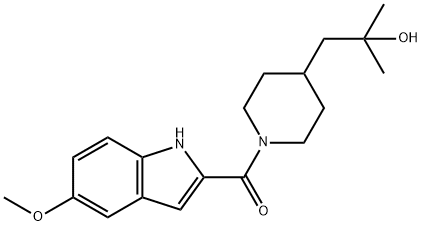
17beta-Hydroxysteroid Dehydrogenase Type 5 Inhibitor ASP9521 is a selective, orally bioavailable inhibitor of 17beta-hydroxysteroid dehydrogenase type 5 (17bHSD5, aldo-keto reductase 1C3; AKR1C3), with potential antineoplastic activity. Upon administration, ASP9521 selectively binds to and inhibits the activity of 17bHSD5. This prevents the conversion of the adrenal androgens dehydroepiandrosterone and androstenedione into 5-androstenediol and testosterone. By blocking testosterone production, ASP9521 may inhibit the growth of testosterone-dependent cancers such as castration-resistant prostate cancer (CRPC). 17bHSD5, expressed both in normal prostate tissue and in prostate cancer (PC), plays a crucial role in persistent production of androgens despite castration; its expression is associated with increased malignancy of PC.