
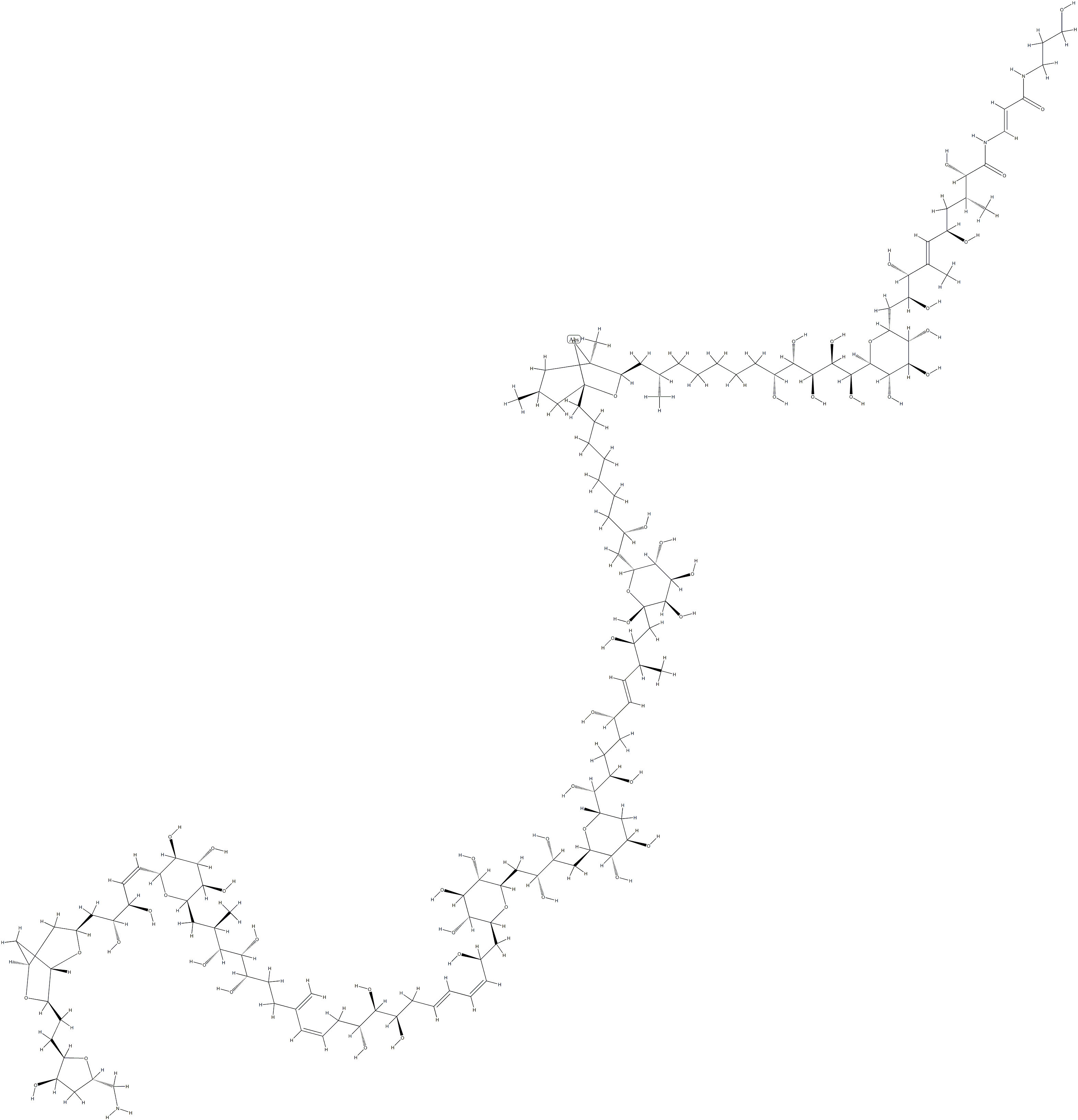
CHEMICAL AND PHYSICAL PROPERTIES
| Color/Form | Non-crystalline /solid/ |
|---|---|
| Solubility | Water soluble substance |
| Stability/Shelf Life | Stable. |
| Decomposition | Hazardous Decomposition Products: Carbon monoxide, Carbon dioxide, Nitrogen oxides. |
| Polymerization | Hazardous Polymerization: Will not occur |
| Other Experimental Properties | Extremely poisonous |
| Chemical Classes | other linear non-peptide (palytoxin) |
COMPUTED DESCRIPTORS
| Molecular Weight | 2680.1 g/mol |
|---|---|
| XLogP3 | -6.6 |
| Hydrogen Bond Donor Count | 45 |
| Hydrogen Bond Acceptor Count | 55 |
| Rotatable Bond Count | 80 |
| Exact Mass | 2679.4829484 g/mol |
| Monoisotopic Mass | 2678.4795936 g/mol |
| Topological Polar Surface Area | 1030 Ų |
| Heavy Atom Count | 186 |
| Formal Charge | 0 |
| Complexity | 5250 |
| Isotope Atom Count | 0 |
| Defined Atom Stereocenter Count | 64 |
| Undefined Atom Stereocenter Count | 0 |
| Defined Bond Stereocenter Count | 7 |
| Undefined Bond Stereocenter Count | 0 |
| Covalently-Bonded Unit Count | 1 |
| Compound Is Canonicalized | Yes |
PRODUCT INTRODUCTION
description
Palytoxin is a polyol marine coelenterate toxin composed of substituted N-3-hydroxypropyl-trans-3-amidoacrylamides and produced by species of Palythoa and Zoanthus soft corals (collectively called zoantharians), either as a defence mechanism or to assist them in capturing prey. An ionophore that forms cation channels through Na+/K+-ATPase, it is a potent vasoconstrictor useful in evaluation of anti-angina agents. It is considered to be one of the most poisonous non-protein substances known, second only to maitotoxin in terms of toxicity in mice. It has a role as a toxin.