
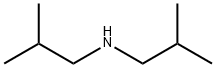
CHEMICAL AND PHYSICAL PROPERTIES
| Physical Description | Diisobutylamine appears as a clear colorless liquid with an ammonia-like odor. Insoluble in water and less dense than water. Hence floats on water. Vapors heavier than air. Toxic oxides of nitrogen produced during combustion. |
|---|---|
| Color/Form | Water-white liquid |
| Odor | Amine odor |
| Boiling Point | 282 to 284 °F at 760 mmHg (NTP, 1992) |
| Melting Point | -100.3 °F (NTP, 1992) |
| Flash Point | 85 °F (NTP, 1992) |
| Solubility | Slightly soluble (NTP, 1992) |
| Density | 0.745 at 68 °F (USCG, 1999) - Less dense than water; will float |
| Vapor Density | 4.46 (NTP, 1992) - Heavier than air; will sink (Relative to Air) |
| Vapor Pressure | 10 mmHg at 97 °F (NTP, 1992) |
| LogP | 2.63 |
| Autoignition Temperature | 554 °F (USCG, 1999) |
| Decomposition | When heated to decomposition it emits toxic fumes of nitroxides. |
| Odor Threshold | Odor Threshold Low: 0.1 [mmHg] Odor Threshold High: 0.3 [mmHg] Odor threshold from CHEMINFO |
| Refractive Index | Index of refraction: 1.4090 @ 20 °C/D; Sadtler reference number: 2246 (IR, Prism) |
| Dissociation Constants | pKa = 10.91 at 21 °C (conjugate acid) |
| Kovats Retention Index | 850 849 |
| Chemical Classes | Nitrogen Compounds -> Amines, Aliphatic |
SAFETY INFORMATION
| Signal word | Danger |
|---|---|
| Pictogram(s) |
 Flame Flammables GHS02  Corrosion Corrosives GHS05  Skull and Crossbones Acute Toxicity GHS06 |
| GHS Hazard Statements |
H226:Flammable liquids H301:Acute toxicity,oral H314:Skin corrosion/irritation H412:Hazardous to the aquatic environment, long-term hazard |
| Precautionary Statement Codes |
P210:Keep away from heat/sparks/open flames/hot surfaces. — No smoking. P273:Avoid release to the environment. P280:Wear protective gloves/protective clothing/eye protection/face protection. P303+P361+P353:IF ON SKIN (or hair): Remove/Take off Immediately all contaminated clothing. Rinse SKIN with water/shower. P305+P351+P338:IF IN EYES: Rinse cautiously with water for several minutes. Remove contact lenses, if present and easy to do. Continuerinsing. |
COMPUTED DESCRIPTORS
| Molecular Weight | 129.24 g/mol |
|---|---|
| XLogP3 | 2.5 |
| Hydrogen Bond Donor Count | 1 |
| Hydrogen Bond Acceptor Count | 1 |
| Rotatable Bond Count | 4 |
| Exact Mass | 129.151749610 g/mol |
| Monoisotopic Mass | 129.151749610 g/mol |
| Topological Polar Surface Area | 12 Ų |
| Heavy Atom Count | 9 |
| Formal Charge | 0 |
| Complexity | 49.6 |
| Isotope Atom Count | 0 |
| Defined Atom Stereocenter Count | 0 |
| Undefined Atom Stereocenter Count | 0 |
| Defined Bond Stereocenter Count | 0 |
| Undefined Bond Stereocenter Count | 0 |
| Covalently-Bonded Unit Count | 1 |
| Compound Is Canonicalized | Yes |
PRODUCT INTRODUCTION
description
Diisobutylamine appears as a clear colorless liquid with an ammonia-like odor. Insoluble in water and less dense than water. Hence floats on water. Vapors heavier than air. Toxic oxides of nitrogen produced during combustion.