
109-77-3
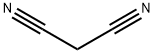
Product Name:
Malononitrile
Formula:
C3H2N2
Synonyms:
Dicyanomethane;Malonodinitrile;Malononitrile
Inquiry
CHEMICAL AND PHYSICAL PROPERTIES
| Physical Description | Malononitrile appears as a white-colored crystalline solid. Denser than water and soluble in water. Toxic by ingestion and may severely irritate skin and eyes. May polymerize violently if exposed to temperatures above 266 °F. Used to make other chemicals. |
|---|---|
| Color/Form | Colorless solid |
| Boiling Point | 424 to 426 °F at 760 mmHg (EPA, 1998) |
| Melting Point | 90 °F (EPA, 1998) |
| Flash Point | 266 °F (EPA, 1998) |
| Solubility | greater than or equal to 100 mg/mL at 72.5 °F (NTP, 1992) |
| Density | 1.191 at 68 °F (EPA, 1998) - Denser than water; will sink |
| Vapor Density | Relative vapor density (air = 1): 2.3 |
| Vapor Pressure | 0.2 [mmHg] |
| LogP | log Kow = -0.60 |
| Stability/Shelf Life | The stability of the molten nitrile decreases with increasing temperature and decreasing purity, but no violent decomposition at below 100 °C has been recorded. |
| Decomposition | When heated to decomposition it emits toxic fumes of NOx and CN- /nitrogen oxides and cyanides/. |
| Ionization Potential | 12.88 eV |
| Polymerization | ... Malononitrile may polymerise violently on heating at 130 °C, or in contact with strong bases at lower temperatures. |
| Refractive Index | Index of refraction: 1.4146 @ 34 °C/D |
| Dissociation Constants | pKa = 11.40 |
| Kovats Retention Index | 801 774.4 |
| Other Experimental Properties | Dipole moment = 1.19X10⁻²⁹ C-m @ 25 °C |
| Chemical Classes | Nitrogen Compounds -> Nitriles |
SAFETY INFORMATION
| Signal word | Danger |
|---|---|
| Pictogram(s) |
 Skull and Crossbones Acute Toxicity GHS06  Environment GHS09 |
| GHS Hazard Statements |
H300:Acute toxicity,oral H317:Sensitisation, Skin H319:Serious eye damage/eye irritation H410:Hazardous to the aquatic environment, long-term hazard |
| Precautionary Statement Codes |
P273:Avoid release to the environment. P280:Wear protective gloves/protective clothing/eye protection/face protection. P301+P310:IF SWALLOWED: Immediately call a POISON CENTER or doctor/physician. P305+P351+P338:IF IN EYES: Rinse cautiously with water for several minutes. Remove contact lenses, if present and easy to do. Continuerinsing. |
COMPUTED DESCRIPTORS
| Molecular Weight | 66.06 g/mol |
|---|---|
| XLogP3 | -0.5 |
| Hydrogen Bond Donor Count | 0 |
| Hydrogen Bond Acceptor Count | 2 |
| Rotatable Bond Count | 0 |
| Exact Mass | 66.021798072 g/mol |
| Monoisotopic Mass | 66.021798072 g/mol |
| Topological Polar Surface Area | 47.6 Ų |
| Heavy Atom Count | 5 |
| Formal Charge | 0 |
| Complexity | 82.6 |
| Isotope Atom Count | 0 |
| Defined Atom Stereocenter Count | 0 |
| Undefined Atom Stereocenter Count | 0 |
| Defined Bond Stereocenter Count | 0 |
| Undefined Bond Stereocenter Count | 0 |
| Covalently-Bonded Unit Count | 1 |
| Compound Is Canonicalized | Yes |
PRODUCT INTRODUCTION
description
Malononitrile appears as a white-colored crystalline solid. Denser than water and soluble in water. Toxic by ingestion and may severely irritate skin and eyes. May polymerize violently if exposed to temperatures above 266 °F. Used to make other chemicals.