
CHEMICAL AND PHYSICAL PROPERTIES
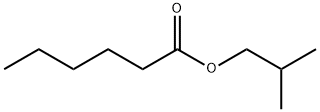
| Physical Description | Isobutyl caproate appears as a liquid. Insoluble in water and less dense than water. Contact may irritate skin, eyes and mucous membranes. May be toxic by ingestion, inhalation or skin absorption. Used to make other chemicals. |
|---|---|
| Solubility | 1 ml in 2 ml 80% alcohol (in ethanol) |
| Density | 0.854-0.858 |
| Refractive Index | 1.410-1.418 |
| Kovats Retention Index | 1152 1140 1136 1137 1133 1144 1138 1138 1138 1139 1142 1135 1131 1133 1119 1140 1140 1140 |
SAFETY INFORMATION
| Signal word | Warning |
|---|---|
| Pictogram(s) |
 Exclamation Mark Irritant GHS07 |
| GHS Hazard Statements |
H315:Skin corrosion/irritation H319:Serious eye damage/eye irritation |
| Precautionary Statement Codes |
P264:Wash hands thoroughly after handling. P264:Wash skin thouroughly after handling. P280:Wear protective gloves/protective clothing/eye protection/face protection. P302+P352:IF ON SKIN: wash with plenty of soap and water. P305+P351+P338:IF IN EYES: Rinse cautiously with water for several minutes. Remove contact lenses, if present and easy to do. Continuerinsing. P332+P313:IF SKIN irritation occurs: Get medical advice/attention. P337+P313:IF eye irritation persists: Get medical advice/attention. |
COMPUTED DESCRIPTORS
| Molecular Weight | 172.26 g/mol |
|---|---|
| XLogP3 | 3.4 |
| Hydrogen Bond Donor Count | 0 |
| Hydrogen Bond Acceptor Count | 2 |
| Rotatable Bond Count | 7 |
| Exact Mass | 172.146329876 g/mol |
| Monoisotopic Mass | 172.146329876 g/mol |
| Topological Polar Surface Area | 26.3 Ų |
| Heavy Atom Count | 12 |
| Formal Charge | 0 |
| Complexity | 119 |
| Isotope Atom Count | 0 |
| Defined Atom Stereocenter Count | 0 |
| Undefined Atom Stereocenter Count | 0 |
| Defined Bond Stereocenter Count | 0 |
| Undefined Bond Stereocenter Count | 0 |
| Covalently-Bonded Unit Count | 1 |
| Compound Is Canonicalized | Yes |
PRODUCT INTRODUCTION
description
Isobutyl caproate appears as a liquid. Insoluble in water and less dense than water. Contact may irritate skin, eyes and mucous membranes. May be toxic by ingestion, inhalation or skin absorption. Used to make other chemicals.