
101-20-2
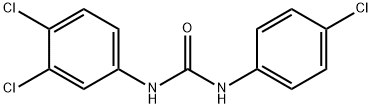
Product Name:
Triclocarban
Formula:
C13H9Cl3N2O
Synonyms:
1-(4-Chlorophenyl)-3-(3,4-dichlorophenyl)urea;3,4,4′-Trichlorocarbanilide;TCC;Triclocarban
Inquiry
CHEMICAL AND PHYSICAL PROPERTIES
| Physical Description | Triclocarban appears as fine white plates or white powder. (NTP, 1992) |
|---|---|
| Color/Form | Fine white plates |
| Odor | Slight, characteristic odor |
| Boiling Point | 250 °C at 97.8 kPa (733 mm Hg) |
| Melting Point | 482 to 493 °F (NTP, 1992) |
| Solubility | less than 1 mg/mL at 79 °F (NTP, 1992) |
| Density | 0.336 g/cu cm at 20 °C |
| LogP | log Kow = 4.342 at 25 °C, pH 8.1 |
| Stability/Shelf Life | Stable under recommended storage conditions. |
| Decomposition | Hazardous decomposition products formed under fire conditions - Carbon oxides, nitrogen oxides (NOx), hydrogen chloride gas. |
| Dissociation Constants | pKa = 12.7 |
| Other Experimental Properties | Heat resistant |
| Chemical Classes | Other Uses -> Biocides/Disinfectants |
SAFETY INFORMATION
| Signal word | Warning |
|---|---|
| Pictogram(s) |
 Environment GHS09 |
| GHS Hazard Statements |
H410:Hazardous to the aquatic environment, long-term hazard |
| Precautionary Statement Codes |
P273:Avoid release to the environment. P501:Dispose of contents/container to..… |
COMPUTED DESCRIPTORS
| Molecular Weight | 315.6 g/mol |
|---|---|
| XLogP3 | 5.3 |
| Hydrogen Bond Donor Count | 2 |
| Hydrogen Bond Acceptor Count | 1 |
| Rotatable Bond Count | 2 |
| Exact Mass | 313.978046 g/mol |
| Monoisotopic Mass | 313.978046 g/mol |
| Topological Polar Surface Area | 41.1 Ų |
| Heavy Atom Count | 19 |
| Formal Charge | 0 |
| Complexity | 308 |
| Isotope Atom Count | 0 |
| Defined Atom Stereocenter Count | 0 |
| Undefined Atom Stereocenter Count | 0 |
| Defined Bond Stereocenter Count | 0 |
| Undefined Bond Stereocenter Count | 0 |
| Covalently-Bonded Unit Count | 1 |
| Compound Is Canonicalized | Yes |
PRODUCT INTRODUCTION
description
Triclocarban appears as fine white plates or white powder. (NTP, 1992)