
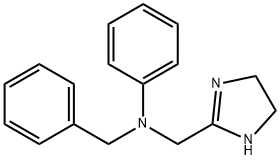
CHEMICAL AND PHYSICAL PROPERTIES
| Physical Description | Solid |
|---|---|
| Color/Form | White, crystalline powder |
| Odor | Odorless |
| Taste | Bitter |
| Melting Point | 227-229 |
| Solubility | 663 mg/L (at 30 °C) |
| Decomposition | When heated to decomposition it emits toxic fumes of /nitrogen oxides/. |
| Kovats Retention Index | 2280 2315 2295 2320 2330 2328 |
COMPUTED DESCRIPTORS
| Molecular Weight | 265.35 g/mol |
|---|---|
| XLogP3 | 2.6 |
| Hydrogen Bond Donor Count | 1 |
| Hydrogen Bond Acceptor Count | 2 |
| Rotatable Bond Count | 5 |
| Exact Mass | 265.157897619 g/mol |
| Monoisotopic Mass | 265.157897619 g/mol |
| Topological Polar Surface Area | 27.6 Ų |
| Heavy Atom Count | 20 |
| Formal Charge | 0 |
| Complexity | 314 |
| Isotope Atom Count | 0 |
| Defined Atom Stereocenter Count | 0 |
| Undefined Atom Stereocenter Count | 0 |
| Defined Bond Stereocenter Count | 0 |
| Undefined Bond Stereocenter Count | 0 |
| Covalently-Bonded Unit Count | 1 |
| Compound Is Canonicalized | Yes |
PRODUCT INTRODUCTION
description
Antazoline is a member of the class of imidazolines that is 2-aminomethyl-2-imidazoline in which the exocyclic amino hydrogens are replaced by benzyl and phenyl groups. Antazoline is only found in individuals that have taken the drug. It has a role as a H1-receptor antagonist, a cholinergic antagonist and a xenobiotic. It is a tertiary amino compound, an aromatic amine and a member of imidazolines.