
SAFETY INFORMATION
| Signal word | Warning |
|---|---|
| Pictogram(s) |
 Environment GHS09 |
| GHS Hazard Statements |
H410:Hazardous to the aquatic environment, long-term hazard |
| Precautionary Statement Codes |
P273:Avoid release to the environment. |
COMPUTED DESCRIPTORS
| Molecular Weight | 506.2 g/mol |
|---|---|
| XLogP3 | 6.1 |
| Hydrogen Bond Donor Count | 2 |
| Hydrogen Bond Acceptor Count | 9 |
| Rotatable Bond Count | 4 |
| Exact Mass | 505.0019374 g/mol |
| Monoisotopic Mass | 505.0019374 g/mol |
| Topological Polar Surface Area | 80.3 Ų |
| Heavy Atom Count | 33 |
| Formal Charge | 0 |
| Complexity | 694 |
| Isotope Atom Count | 0 |
| Defined Atom Stereocenter Count | 0 |
| Undefined Atom Stereocenter Count | 0 |
| Defined Bond Stereocenter Count | 0 |
| Undefined Bond Stereocenter Count | 0 |
| Covalently-Bonded Unit Count | 1 |
| Compound Is Canonicalized | Yes |
PRODUCT INTRODUCTION
description
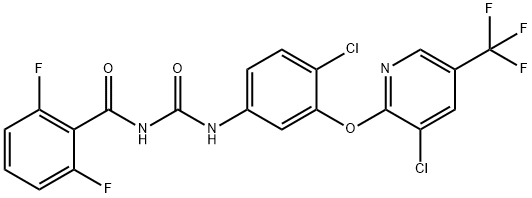
Fluazuron is an N-acylurea that is urea in which one of the hydrogens has been replaced by a 3,6-difluorobenzoyl group, while a hydrogen attached to the other nitrogen has been replaced by a 4-chloro-3-{[3-chloro-5-(trifluoromethyl)pyridin-2-yl]oxy}phenyl group. It is used to control ticks in cattle. It has a role as a mite growth regulator and an acaricide. It is an organofluorine acaricide, an organochlorine acaricide, a member of monochlorobenzenes, a N-acylurea, a chloropyridine, an aromatic ether and a member of phenylureas.