
65646-68-6
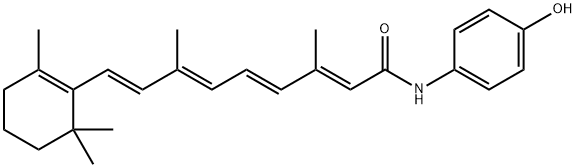
Product Name:
4-HYDROXYPHENYLRETINAMIDE
Formula:
C26H33NO2
Synonyms:
HPR;Fenretinide;Fenretinide, 4HPR, N-(4-Hydroxyphenyl)-all- trans Retinamide;Haptoglobin-related protein;4-HPR
Inquiry
CHEMICAL AND PHYSICAL PROPERTIES
| Collision Cross Section | 200.5 Ų [M+H]+ [CCS Type: TW, Method: calibrated with polyalanine and drug standards] |
|---|
SAFETY INFORMATION
| Signal word | Danger |
|---|---|
| Pictogram(s) |
 Exclamation Mark Irritant GHS07  Health Hazard GHS08 |
| GHS Hazard Statements |
H315:Skin corrosion/irritation H319:Serious eye damage/eye irritation H335:Specific target organ toxicity, single exposure;Respiratory tract irritation H360:Reproductive toxicity |
| Precautionary Statement Codes |
P201:Obtain special instructions before use. P280:Wear protective gloves/protective clothing/eye protection/face protection. P308+P313:IF exposed or concerned: Get medical advice/attention. |
COMPUTED DESCRIPTORS
| Molecular Weight | 391.5 g/mol |
|---|---|
| XLogP3 | 7.3 |
| Hydrogen Bond Donor Count | 2 |
| Hydrogen Bond Acceptor Count | 2 |
| Rotatable Bond Count | 6 |
| Exact Mass | 391.251129295 g/mol |
| Monoisotopic Mass | 391.251129295 g/mol |
| Topological Polar Surface Area | 49.3 Ų |
| Heavy Atom Count | 29 |
| Formal Charge | 0 |
| Complexity | 726 |
| Isotope Atom Count | 0 |
| Defined Atom Stereocenter Count | 0 |
| Undefined Atom Stereocenter Count | 0 |
| Defined Bond Stereocenter Count | 4 |
| Undefined Bond Stereocenter Count | 0 |
| Covalently-Bonded Unit Count | 1 |
| Compound Is Canonicalized | Yes |
PRODUCT INTRODUCTION
description
4-hydroxyphenyl retinamide is a retinoid obtained by formal condensation of the carboxy group of all-trans retinoic acid and the anilino group of 4-hydroxyaniline. Synthetic retinoid agonist. Antiproliferative, antioxidant and anticancer agent with a long half-life in vivo. Apoptotic effects appear to be mediated by a mechanism distinct from that of 'classical' retinoids. It has a role as an antineoplastic agent and an antioxidant. It is a retinoid and a monocarboxylic acid amide. It is functionally related to an all-trans-retinoic acid.