
4170-30-3
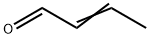
Product Name:
CROTONALDEHYDE
Formula:
C4H6O
Synonyms:
2-Butenal, mixture of cis and trans
Inquiry
CHEMICAL AND PHYSICAL PROPERTIES
| Physical Description | Crotonaldehyde, stabilized appears as a clear colorless to straw colored liquid with a penetrating pungent odor. Flash point 55 °F. Density 7.1 lb / gal. Very toxic by inhalation. May polymerize with the release of heat under exposure to heat or contamination. If polymerization takes place inside a container, the container may rupture violently. Less dense than water. Vapors heavier than air. |
|---|---|
| Color/Form | Water-white, mobile liquid |
| Odor | Pungent, suffocating odor |
| Boiling Point | 219 °F at 760 mmHg (EPA, 1998) |
| Melting Point | -105 °F (EPA, 1998) |
| Flash Point | 55 °F (EPA, 1998) |
| Solubility | less than 0.1 mg/mL at 65.3 °F (NTP, 1992) |
| Density | 0.853 at 68 °F (EPA, 1998) - Less dense than water; will float |
| Vapor Density | 2.41 (EPA, 1998) - Heavier than air; will sink (Relative to Air) |
| Vapor Pressure | 19 mmHg at 68 °F (EPA, 1998) |
| LogP | 0.63 (calculated) |
| Henry's Law Constant | Henry's Law constant = 1.5X10⁻⁵ atm-cu m/mol at 25 °C |
| Stability/Shelf Life | Turns to a pale yellow color in contact with light and air. |
| Autoignition Temperature | 450 °F (USCG, 1999) |
| Decomposition | Hazardous decomposition products formed under fire conditions. - Carbon oxides |
| Heat of Combustion | 2268 kJ/mol (to convert J to cal, divide by 4.184) |
| Heat of Vaporization | 123 cal/g |
| Ionization Potential | 9.73 eV |
| Polymerization | Hazardous polymerization may occur. Polymerization may be caused by elevated temperatures and alkalies. May form explosive peroxides. |
| Odor Threshold | Odor Threshold Low: 0.06 [mmHg] Odor Threshold High: 0.2 [mmHg] Detection odor threshold from AIHA (mean = 0.11 ppm) |
| Refractive Index | Index of refraction: 1.4384 at 17.7 °C |
| Kovats Retention Index | 619 624 622 |
| Other Experimental Properties | Commercial product is a 95:5 mixture of trans:cis isomers |
| Chemical Classes | Toxic Gases & Vapors -> Other Toxic Gases & Vapors |
SAFETY INFORMATION
| Signal word | Danger |
|---|---|
| Pictogram(s) |
 Flame Flammables GHS02  Corrosion Corrosives GHS05  Skull and Crossbones Acute Toxicity GHS06  Health Hazard GHS08  Environment GHS09 |
| GHS Hazard Statements |
H225:Flammable liquids H315:Skin corrosion/irritation H318:Serious eye damage/eye irritation H330:Acute toxicity,inhalation H335:Specific target organ toxicity, single exposure;Respiratory tract irritation H341:Germ cell mutagenicity H373:Specific target organ toxicity, repeated exposure H400:Hazardous to the aquatic environment, acute hazard |
| Precautionary Statement Codes |
P201:Obtain special instructions before use. P210:Keep away from heat/sparks/open flames/hot surfaces. — No smoking. P280:Wear protective gloves/protective clothing/eye protection/face protection. |
COMPUTED DESCRIPTORS
| Molecular Weight | 70.09 g/mol |
|---|---|
| XLogP3 | 0.5 |
| Hydrogen Bond Donor Count | 0 |
| Hydrogen Bond Acceptor Count | 1 |
| Rotatable Bond Count | 1 |
| Exact Mass | 70.041864811 g/mol |
| Monoisotopic Mass | 70.041864811 g/mol |
| Topological Polar Surface Area | 17.1 Ų |
| Heavy Atom Count | 5 |
| Formal Charge | 0 |
| Complexity | 45.6 |
| Isotope Atom Count | 0 |
| Defined Atom Stereocenter Count | 0 |
| Undefined Atom Stereocenter Count | 0 |
| Defined Bond Stereocenter Count | 1 |
| Undefined Bond Stereocenter Count | 0 |
| Covalently-Bonded Unit Count | 1 |
| Compound Is Canonicalized | Yes |
PRODUCT INTRODUCTION
description
Crotonaldehyde is a clear, colorless to straw colored liquid with a strong, suffocating odor. It is highly flammable and produces toxic vapors at room temperature. Crotonaldehyde is found naturally in emissions of some vegetation and volcanoes; many foods contain crotonaldehyde in small amounts. Crotonaldehyde is mainly used in the manufacture of sorbic acid, which is a yeast and mold inhibitor. Crotonaldehyde has been used as a warning agent in fuels, as alcohol denaturant, as stabilizer for tetraethyl-lead, in the preparation of rubber accelerators, and in leather tanning.