
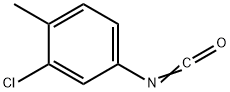
CHEMICAL AND PHYSICAL PROPERTIES
| Physical Description | 3-chloro-4-methylphenyl isocyanate appears as a colorless liquid with an acrid odor. Denser than water. Contact may irritate skin, eyes and mucous membranes. Toxic by ingestion, inhalation and skin absorption. Used to make other chemicals. |
|---|
SAFETY INFORMATION
| Signal word | Danger |
|---|---|
| Pictogram(s) |
 Corrosion Corrosives GHS05  Skull and Crossbones Acute Toxicity GHS06  Health Hazard GHS08  Environment GHS09 |
| GHS Hazard Statements |
H314:Skin corrosion/irritation H317:Sensitisation, Skin H330:Acute toxicity,inhalation H334:Sensitisation, respiratory H335:Specific target organ toxicity, single exposure;Respiratory tract irritation H410:Hazardous to the aquatic environment, long-term hazard |
| Precautionary Statement Codes |
P273:Avoid release to the environment. P280:Wear protective gloves/protective clothing/eye protection/face protection. P301+P312:IF SWALLOWED: call a POISON CENTER or doctor/physician IF you feel unwell. P303+P361+P353:IF ON SKIN (or hair): Remove/Take off Immediately all contaminated clothing. Rinse SKIN with water/shower. P305+P351+P338:IF IN EYES: Rinse cautiously with water for several minutes. Remove contact lenses, if present and easy to do. Continuerinsing. |
COMPUTED DESCRIPTORS
| Molecular Weight | 167.59 g/mol |
|---|---|
| XLogP3 | 4.4 |
| Hydrogen Bond Donor Count | 0 |
| Hydrogen Bond Acceptor Count | 2 |
| Rotatable Bond Count | 1 |
| Exact Mass | 167.0137915 g/mol |
| Monoisotopic Mass | 167.0137915 g/mol |
| Topological Polar Surface Area | 29.4 Ų |
| Heavy Atom Count | 11 |
| Formal Charge | 0 |
| Complexity | 177 |
| Isotope Atom Count | 0 |
| Defined Atom Stereocenter Count | 0 |
| Undefined Atom Stereocenter Count | 0 |
| Defined Bond Stereocenter Count | 0 |
| Undefined Bond Stereocenter Count | 0 |
| Covalently-Bonded Unit Count | 1 |
| Compound Is Canonicalized | Yes |
PRODUCT INTRODUCTION
description
3-chloro-4-methylphenyl isocyanate appears as a colorless liquid with an acrid odor. Denser than water. Contact may irritate skin, eyes and mucous membranes. Toxic by ingestion, inhalation and skin absorption. Used to make other chemicals.