
2540-82-1
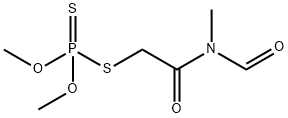
Product Name:
Formothion
Formula:
C6H12NO4PS2
Synonyms:
S-[2-(Formylmethylamino)-2-oxoethyl] O,O-dimethyl dithiophosphate
Inquiry
CHEMICAL AND PHYSICAL PROPERTIES
| Physical Description | Formothion appears as viscous yellow oil or a crystalline mass. Used as an insecticide and acaricide on crops and ornamentals. Not presently produced commercially in the U.S. (EPA, 1998) |
|---|---|
| Color/Form | Yellowish liquid |
| Odor | Odorless |
| Boiling Point | Decomposes on distillation |
| Melting Point | 77 °F (EPA, 1998) |
| Solubility | Completely miscible with common organic solvents, e.g. alcohols, ethers, ketones, chloroform, benzene, toluene, xylene; slightly soluble in hexane; very slightly soluble in ligroin and paraffin oil. |
| Density | 1.361 at 68 °F (EPA, 1998) - Denser than water; will sink |
| Vapor Pressure | 8.5e-06 mmHg at 68 °F (EPA, 1998) |
| LogP | log Kow = 1.48 |
| Stability/Shelf Life | Hydrolyzed by water to dimethoate and (dimethoxyphosphinothioylthio)acetic acid; DT50 < or = 1 day @ pH 3-9 and 23 °C. Hydrolyzed more rapidly in alkaline media. Dilute solutions in non-polar organic solvents are stable. |
| Decomposition | When heated to decomposition it emits very toxic fumes of /nitrogen, phosphorous, and sulfur oxides/. |
| Corrosivity | Non-corrosive in general, tinplate is an exception |
| Refractive Index | INDEX OF REFRACTION: 1.5541 AT 20 °C/D |
| Kovats Retention Index | 1803.7 1839.9 1762 1810.5 1795 1805 1805.4 1810.3 |
| Other Experimental Properties | SOLIDIFIES AT ABOUT 25 °C |
| Chemical Classes | Pesticides -> Organophosphate Insecticides |
SAFETY INFORMATION
| Signal word | Danger |
|---|---|
| Pictogram(s) |
 Flame Flammables GHS02  Skull and Crossbones Acute Toxicity GHS06  Health Hazard GHS08 |
| GHS Hazard Statements |
H226:Flammable liquids H302:Acute toxicity,oral H304:Aspiration hazard H315:Skin corrosion/irritation H319:Serious eye damage/eye irritation H335:Specific target organ toxicity, single exposure;Respiratory tract irritation H373:Specific target organ toxicity, repeated exposure H412:Hazardous to the aquatic environment, long-term hazard |
| Precautionary Statement Codes |
P210:Keep away from heat/sparks/open flames/hot surfaces. — No smoking. P273:Avoid release to the environment. P280:Wear protective gloves/protective clothing/eye protection/face protection. P331:Do NOT induce vomiting. P301+P310:IF SWALLOWED: Immediately call a POISON CENTER or doctor/physician. P303+P361+P353:IF ON SKIN (or hair): Remove/Take off Immediately all contaminated clothing. Rinse SKIN with water/shower. |
COMPUTED DESCRIPTORS
| Molecular Weight | 257.3 g/mol |
|---|---|
| XLogP3 | 1.5 |
| Hydrogen Bond Donor Count | 0 |
| Hydrogen Bond Acceptor Count | 6 |
| Rotatable Bond Count | 5 |
| Exact Mass | 256.99453721 g/mol |
| Monoisotopic Mass | 256.99453721 g/mol |
| Topological Polar Surface Area | 113 Ų |
| Heavy Atom Count | 14 |
| Formal Charge | 0 |
| Complexity | 252 |
| Isotope Atom Count | 0 |
| Defined Atom Stereocenter Count | 0 |
| Undefined Atom Stereocenter Count | 0 |
| Defined Bond Stereocenter Count | 0 |
| Undefined Bond Stereocenter Count | 0 |
| Covalently-Bonded Unit Count | 1 |
| Compound Is Canonicalized | Yes |
PRODUCT INTRODUCTION
description
Formothion appears as viscous yellow oil or a crystalline mass. Used as an insecticide and acaricide on crops and ornamentals. Not presently produced commercially in the U.S. (EPA, 1998)